The Soviet Union was a big dictatorship in the 1900s. It used a lot of force on its own people and nearby lands. But the nearly 70 years from its start after the Russian Civil War in 1922 until it broke into 15 countries in 1991 were not all the same. There were two main times of more openness, about a generation apart. One started with leader Nikita Khrushchev in the 1950s. The other came with Mikhail Gorbachev in the 1980s. We will check out Khrushchev’s easing first, in home rules, world dealings, and money plans. The one on Gorbachev comes in two weeks. Board games will show up too.
Freedom to Think, Speak, and Act in Politics
Under Joseph Stalin, the Soviet Union stopped people from speaking freely. Books tell a lot about his time of fear. But the most famous picture of full control is in George Orwell’s book 1984. That story shows a one-party country that hides true news. People get fed lies all the time and must go along with them, even if they change. Folks have to join in hating enemies every day and worship the top man called Big Brother.
Stalin was the Soviet Big Brother. The government made him seem like a perfect leader who never slept, always protecting the country. Any problems were blamed on bad helpers or hidden foes.
After Stalin died, his top men fought hard for his job. Nikita Khrushchev won out. He had served Stalin well, like his rivals. Right away, he used old Stalin tricks to remove Lavrentiy Beria. Beria ran the home safety forces as Minister of Internal Affairs. They said Beria betrayed the country, had a fake trial, and shot him.

Khrushchev was good at power games both ways. He made a report on Stalin’s bad acts. On February 25, 1956, at the 20th Congress of the Communist Party of the Soviet Union, he told it to shocked listeners. For four hours, he listed Stalin’s killings in the party, moving whole groups away for not being loyal, and building worship of himself like a god.
Khrushchev did not just talk. In the late 1950s and early 1960s, they eased rules on books. Alexander Solzhenitsyn got to print his story about prison camps, One Day in the Life of Ivan Denisovich.
But there were lines. Okay to knock Stalin’s camps. Not okay to question the October Revolution. Boris Pasternak’s Doctor Zhivago did not come out in the Soviet Union. When he won the Nobel Prize for it, state agents scared him and his family. He stayed home and skipped the award in Stockholm.
Even so, Khrushchev’s change marked a big shift from violence. People still got watched and pushed around. But not with Stalin’s huge power or wild surprises. The time when today’s finger-pointer became tomorrow’s target ended.

Peaceful Living Together and Khrushchev’s Other Ideas
Khrushchev’s 1956 talk was to stay secret, just for those there and East Europe friends. But a Polish party man snuck a copy out through Israel’s place in Warsaw. It spread fast. Khrushchev meant it to knock out rivals like Georgy Malenkov and Vyacheslav Molotov at home. But abroad, it helped too. The new Soviet Union looked better to socialists in Europe and new free countries in Africa and Asia.
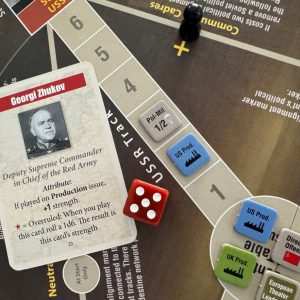
This surprise gain is key in the world-focused Twilight Struggle’s De-Stalinization card. The Soviet side can shift up to four points of pull on the map. It looks like no gain since you just move it. But Soviets often have extra pull in East Europe early. This card gets you to far places like South America best, and a bit Africa.
Even before the leak, Khrushchev’s world ways changed from Stalin’s end. After World War II, ties with old allies soured. Stalin saw two enemy sides. Khrushchev tried peaceful living together with the West. Socialism and free markets could share the world. As a true believer, he thought his way would win later. Meanwhile, it kept peace, made socialism look good, and let money go to growth and home items.
Khrushchev started big ideas but dropped many. Peaceful living led to helping freedom fighters in poor lands or new fights over middle Europe with the West. He let Soviets and West live side by side. But not odd socialist thoughts in his area. When Hungary’s party said leave Warsaw Pact and have free votes, Soviet tanks stopped it.

Home Items, Private Homes, and Corn?
Stalin’s economy pushed big factories for quick growth and army strength. It worked against Nazi attack and won in 1945. Fans of this, tied to strong beliefs and tough world views, called it politika. After death, the tekhnika group rose. They wanted softer world ties, less pep talks, and market touches for more home goods.
Khrushchev took the middle road. Big factories first, since US economy was three times bigger in arms race. But more for home items than before. People got radios, washers, even cars sometimes. He saw it as Cold War fight too. Comfort sways hearts like guns or words.
This boldness led to trade shows with US. Each showed their land to the other’s folks. Soviet one in New York got looks. US one in Moscow drew crowds. It gave the famous Kitchen Debate photo: Khrushchev and Vice President Richard Nixon arguing systems near US kitchen tools.
Some Soviets dreamed of US life. But under Khrushchev, their ways got closer. Housing mattered most. Big cities had kommunalkas: old big flats split for many families, one room each, shared kitchen and bath. No privacy. Only top people had their own. Khrushchev built cheap concrete block homes. Millions got family-only places first time.

Like world policy, he began many money plans but few finished. Virgin Lands tried farming Siberia and north Kazakhstan to end food lacks. It faded quick. His corn push like Iowa’s failed worse. It hurt corn’s name and his.
Khrushchev Gets Removed
Money ups and downs hurt Khrushchev. World jumps from arms deals to Cuba face-off did too. Worst, his party changes upset workers. Mad ones who feared job loss pushed him out in October 1964. They picked steady Leonid Brezhnev as new party head. Brezhnev cut some home openness for tighter books and arts. But kept money shifts and calm West ties.
In the end, Khrushchev gained from his own openness. Unlike 1930s purge victims or Beria, no fake trial or death. He quit for health and lived comfy at country home.
Games Mentioned
Twilight Struggle (Ananda Gupta/Jason Matthews, GMT Games)

Wir sind das Volk: 2+2 (Richard Sivél/Peer Sylvester, Histogame)
Days of Ire (Katalin Nimmerfroh/Dávid Turczi/Mihály Vincze, Cloud Island)
More to Read
The best life story is Taubman, William: Khrushchev. The Man and His Era, Norton, New York City, NY 2004.
A full picture of Soviet daily life, money, and culture is Schlögel, Karl: The Soviet Century. Archaeology of a Lost World, Princeton University Press, Princeton, NJ 2023.
On crushing Hungary revolt and world effects, see Békés, Csaba: The 1956 Hungarian Revolution and World Politics, (Cold War International History Project Working Paper No. 16), Washington, D.C. 1996.
On politika/tekhnika split, see Priestland, David: Cold War Mobilization and Domestic Politics: the Soviet Union, in: Leffler, Melvyn P./Westad, Odd Arne (eds.): The Cambridge History of the Cold War. Volume I. Origins, 5th edition, Cambridge University Press, Cambridge 2013, pp. 442-463.