Hexasim has really been making better games lately. They have some great looking wargames. Late last year, they told everyone about their newest game. The game is called La Der des Ders – The War to End War. It focuses on World War I. The game is designed by Arnauld Della Siega. We reached out to Arnauld. He was more than willing to give us some insight into the design.
Grant: Arnauld welcome to our blog. First off please tell us a little about yourself. What are your hobbies? What is your day job?
Arnauld: Hello, everyone. Despite my Italian-sounding name, I am French. My hobbies? Gaming, of course. Formula 1. American football and flag football. I am an assistant coach for my youngest son’s team. Oh, and I play badminton. And when I had a little more time, I did astronomy. Add Motörhead and Lovecraft to that, and I think you will have a pretty good idea of who I am. My real job? I have been working for Hexasim for three years. I mainly handle communication and game development. This includes clarity of the rules, layout of the rulebook, and some of the graphics.
Grant: What motivated you to break into game design? What have you enjoyed most about the experience thus far?
Arnauld: I think this is true of many designers. My brain is constantly buzzing. Whether I am writing stories or inventing game systems, I am always thinking. I wanted to create something to give shape to the ideas swirling around in my head. Then, and perhaps most importantly, to leave something behind for my descendants. Creating is more frustrating than rewarding. But seeing your game released is a bit like the birth of a child. It is a culmination.
Grant: What is your upcoming game La Der des Ders about?
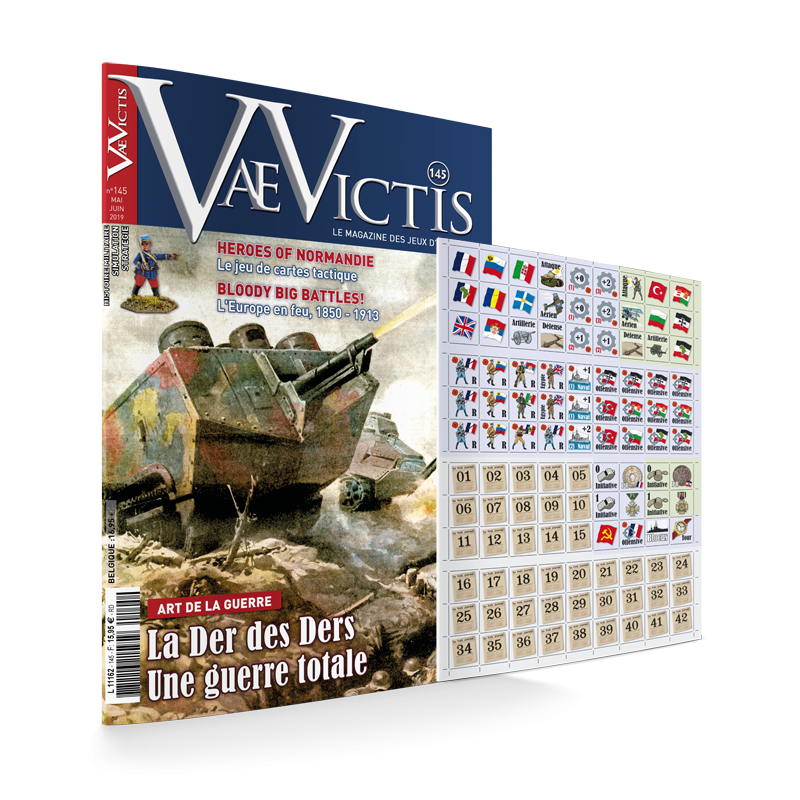
Arnauld: La Der des Ders is the story of the First World War in its entirety. It goes from the early stages to 11 November. And even a little beyond. It follows the timeline of the war and focuses on technological developments. La Der des Ders is a grand-strategy game. In this game, you control sectors. You decide how to allocate your resources. You can recruit new soldiers to rebuild your forces, do technological research, or prepare offensives. La Der des Ders is a revised and corrected version. It has greatly improved artworks, ergonomics, and rules. It was published in VaeVictis Magazine #145.
Grant: What is the translation of this French phrase La Der de Ders?
Arnauld: La Der des Ders means « the last of the last ». You may translate it by « The War to End War ». I asked my testers and Boardgame Geek whether to use a French or English title. The players unanimously opted for a French one.
Grant: Why was this a subject you wanted to create a game on?
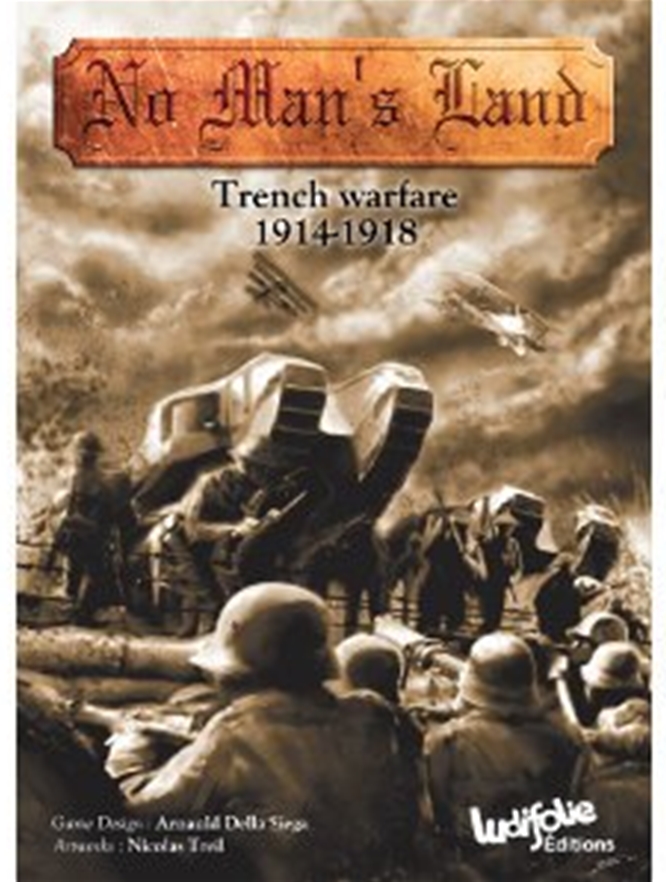
Arnauld: After creating No Man’s Land – Trench Warfare1914-1918 from Ludifolie Editions, I had acquired a good amount of knowledge about the First World War at a tactical level. I thought it would be a good idea to take a step back. I wanted to look at the First World War from a different angle. That is how La Der des Ders came about.
Grant: What are the unique features with the system used for the game?
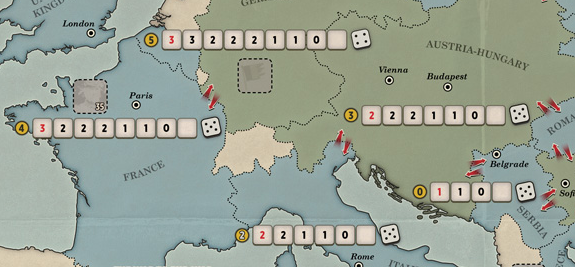
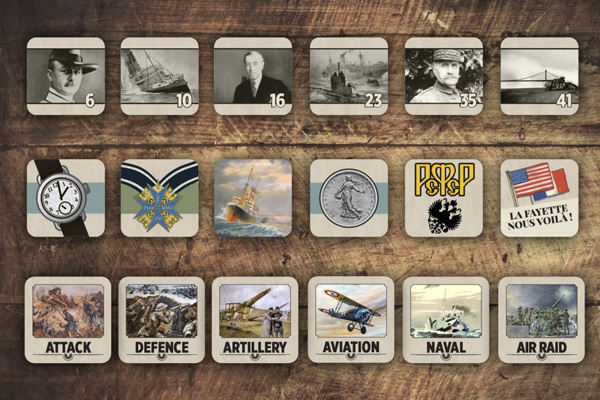
Arnauld: It depends on what we mean by unique. Are there any truly unique games? When it was released in 2019, La Der des Ders was, to my knowledge, the only solo game covering the entire First World War. What makes it unique is its focus on technology. The game includes 41 levels of technology. It is also this abstraction which facilitates the narrative without distorting it. This is particularly evident in the Collapse Tracks. These tracks manage the erosion of the belligerents.
Grant: What is your design goal with the game?
Arnauld: What I look for above all else in a game is elegance. I like it when a lot of thought has gone into it. This applies to both the ergonomics and the gameplay. For La Der des Ders, I wanted to create a game that was easy to learn. It is designed for solo play and has engaging mechanics. It is a game made to be played and able to learn more about the historical WW1.
Grant: What unique elements from WWI did you feel important to model in the game?
Arnauld: I think that sometimes a game is less about what is important to model. It is more about what the designer wants to model. I like the technical side of conflict. For this reason, 1914 interests me much less than 1918. I love all the technologies that abound. It was the shape of those funny steampunk-style tanks that made me love WW1. Basically, I am more into Francis I, the Assyrians, and the like.
Grant: As a Strategic Level wargame, what economic or political elements are included?
Arnauld: The entry of neutral countries into the war is managed by events. I did not want countries to be able to adopt a stance different from their historical one. That would have had too much of an impact on historicity. Neutral countries will therefore certainly enter the war in the same year as historically. But players do not really know on which turn. One turn equals 4 months.
The economy is managed by Re
Grant: How does the Collapse Track work?
Arnauld: The Collapse Track represents both a sector’s willingness to fight and its military potential. With each loss, a cube moves to the right, towards surrender. These losses also reduce the number of Attack dice a sector can roll during an offensive. Spending resources allows you to counteract this slow erosion and regain power.

Grant: What technologies can be developed?
Arnauld: There are six categories of Technology. These are Attack, Defense, Artillery, Air, Naval, and Raid. Each category is divided into several levels. These levels are specific to each side.
Once unlocked, Technology levels grant bonuses in attack or defense. They also give Artillery dice, rerolls, bonuses during the Naval Control Phase, or the ability to cancel some events. The Naval Control Phase reduces the number of Re
Grant: How does the game use cards?
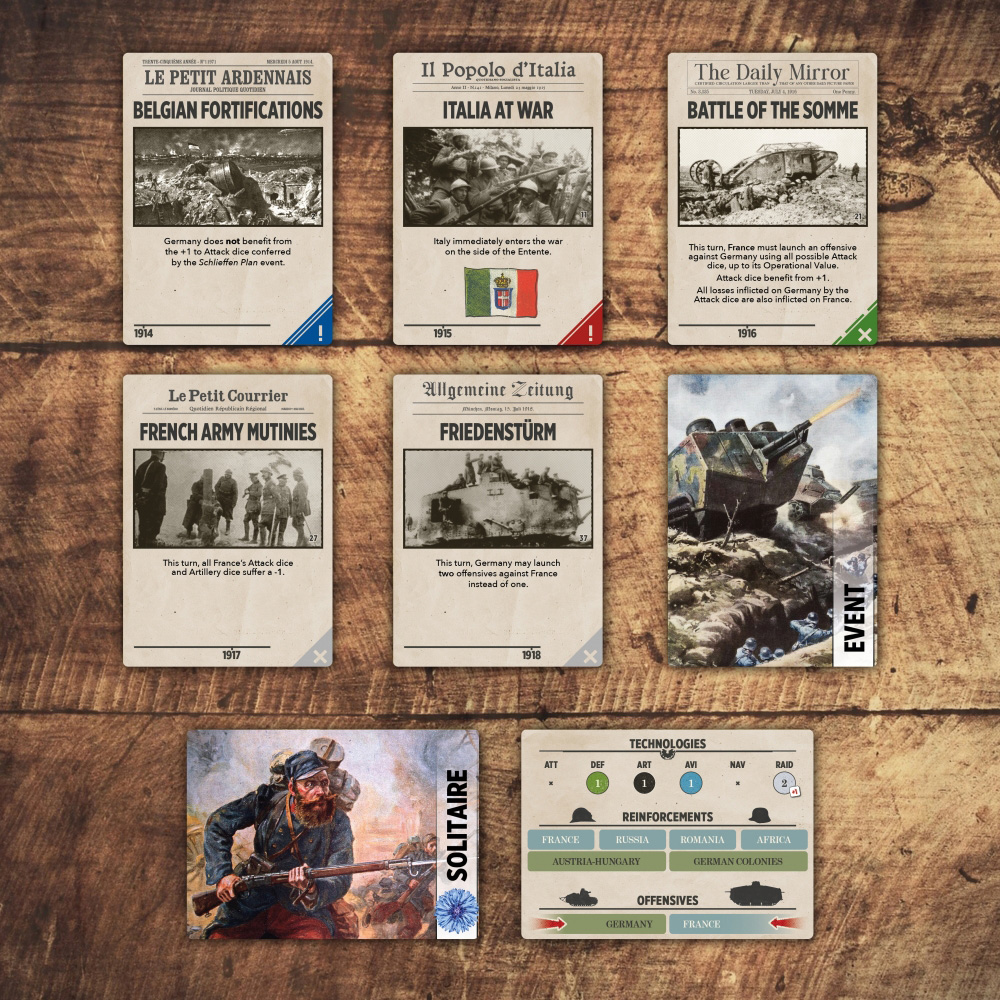
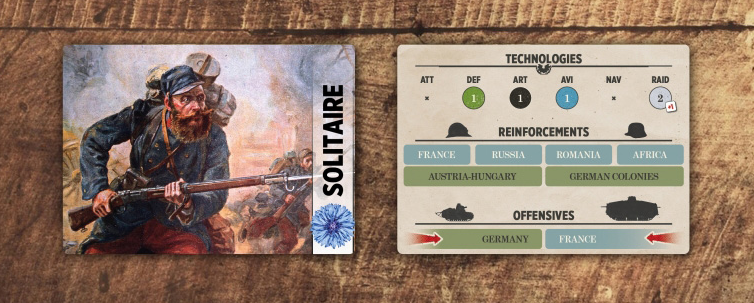
Arnauld: There are two types of cards. Cornflower Cards are used to manage the solitaire bot.
The other cards are Events. Three are drawn at the beginning of each turn, and the effects are applied. Events are classified by year. One card remains at the end of each year when the new year’s deck is brought into play. This adds variety to the game without sacrificing historical timeline.
What I am most proud of with these cards are the top banners. I made sure to copy the headlines from newspapers of the time. I went so far as to put a credible date and, above all, a number that, unless I am mistaken, should be correct. Yes, I had a lot of fun.
Grant: What different types of cards are included? Can you provide a few examples?
Arnauld: There are several types of Event Cards. Blue cards, such as the Schlieffen Plan, are only available in 1914. Red cards are Pivotal Cards that cannot be cancelled. These include cards that bring countries into the war, such as Lusitania and Zimmermann Telegram. Finally, green cards, which are the most numerous, allow players to obtain Re
Grant: How does combat work?
Arnauld: Combat is referred to as offensives. A single sector can only launch one offensive per turn. A single sector can be attacked by multiple sectors. The player chooses the attacking sector and designates its target. They spend a number of Re
Artillery technology is important. It allows black dice to be rolled that will not be modified. This highlights the power of artillery during conflict.
Grant: How are historical events handled?
Arnauld: By drawing three cards at the beginning of each turn. The cards do not go into the players’ hands. They are applied during the current turn. Some are applied immediately, others during offensives, and a few during the Re
Grant: What variants are included?
Arnauld: The Fast Play variant speeds up games. It brings this version closer to the original version published in VaeVictis. It removes the two new Technology categories and does not charge sectors for implementing unlocked technology levels. I do not really like it when a designer offers variants. It makes me think that they have not taken responsibility and are leaving it up to the player to figure it out.
You know what? I am going to offer your fellow readers a great variant. This variant is for use in 1 vs 1 games. Use it if you find it too difficult to win with the Entente.
Here it is:
Countries that are still neutral do not pay to implement an unlocked technology. Once the sector is at war, they must pay as normal.
You can consider this variant official. It has been tested.
Grant: How does the solitaire mode work? How are the Cornflower Cards used?
Arnauld: For each phase (Reinforcements, Technological Research, Offensives), the player draws a card and refers to what is indicated on the card.
It is very simple to set up and effective. No need for endless dice rolls, referring to multiple tables, or having to make decisions for your opponent. Everything is indicated on the card. It is elegant. Players seem to love this simplicity and the relevance of the decisions made by the bot.
Grant: How is victory achieved?
Arnauld: Victory can be achieved in several ways. Either by forcing France or Germany to surrender. Or by earning 6 Victory points. These are obtained by forcing the enemy sectors to surrender. Or at the end of the game. The game ends when the Peace Negotiations Card is drawn. At that point, the side with the most Prestige Points wins. Prestige is calculated according to the position of the cubes on each of the Collapse Tracks.
Grant: What do you feel the game models well?
Arnauld: You can really feel the Entente gaining strength. They have more and more resources at their disposal thanks to British and American support. Germany has an obligation to finish the war as quickly as possible before the task becomes insurmountable.
But I also particularly like the story that the game tells. It is very close to the actual historical timeline.
Grant: What are you most pleased about with the design?
Arnauld: I like the fact that it is both simple and interesting. I like the fact that Dad can play with Junior. I like that players learn things while playing. I like the way it looks. And I like the price. We decided to make this game as affordable as possible so that more people could enjoy it. Games should not be a luxury item.
Grant: What other designs are you contemplating or already working on?
Arnauld: I have several projects in mind, mostly solo games. Some are well advanced, but I feel like I am at a crossroads. I mean… there are too many games coming out. Designers need to learn to restrain themselves. Rather than flooding the market with games that are sometimes barely finished, they should take the time to polish them as much as possible. They need to perfect the rulebook, which is often really awful. Given the price of games, I believe we should respect players and offer them flawless products. Fewer games, but higher quality. And that is good, because that is exactly Hexasim’s credo. If sales of La Der des Ders are fantastic, we can plan a sequel. Perhaps World War II, to please as many people as possible, and/or fantasy. The ratings received on Boardgame Geek will decide.
If you are interested in La Der des Ders – The War to End War, you can order a copy for 49.90 €. This is about $57.52 in US Dollars. You can get it from the Hexasim website. The link is on their site.