Games + History = Life.
Here are the three that gave me most life this year!
You can read all of the Farewell 2025 posts here:
- Farewell 2025 – New-to-Me Games!
- Farewell 2025 – Historical Fiction!
- Farewell 2025 – Non-Historical Games!
- Farewell 2025 – Historical Non-Fiction!
- Farewell 2025 – Historical Games!
- Farewell 2025 – Best on the Blog!

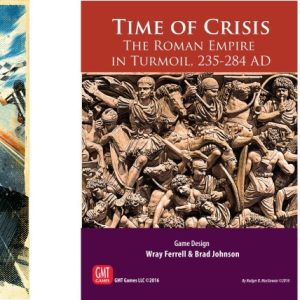
©Rodger B. MacGowan. Time of Crisis (Wray Ferrell/Brad Johnson, GMT Games)
I love a good ancient game. The Greeks and Romans provide not only ample literary and archaeological sources (which are the basis for any decent scholarship, and consequently, for games which take their history seriously), but also the right touch of drama to go with it. Yet while everyone know about the drama of the Greeks defying the Persian Empire or Rome’s struggle with Hannibal, late antiquity gets short shrift in popular media, games included. Time of Crisis does its part to remedy that, shedding light on the crisis of the third century in the Roman Empire which saw no fewer than 19 emperors in the fifty years the game covers (with several dozen co-emperors, emperors of secessionist empires, and anti-emperors who never gained legitimacy on top).

Time of Crisis is by no means a simulation. However, it does give you an idea of the sheer chaos of civil war, external invasions, social and economic upheaval, and quasi-constant usurpation… and it does so in a very entertaining way, daring you to wreck the Roman Empire in an enjoyable short evening.

Julius Caesar (Grant Dalgliesh/Justin Thompson, Columbia Games)
Did I say I love ancient games? Here’s exhibit B.
Julius Caesar takes two players to the final years of the Roman Republic, when Caesar and Pompey struggled for mastery of Rome. While the rules are the same for both sides, they play very differently: Caesar commands high-quality veterans of his Gallic campaigns, concentrated in Gaul (both transalpine and cisalpine), whereas Pompey’s more numerous, but greener troops are spread out all over the Mediterranean. Caesar will thus have an edge attacking… and attack he must, as the initial score (measured by control of objective cities) is 7-1 in Pompey’s favor.

That does not mean, though, that Pompey is only digging in. Pre-emptive movements to take victory cities and move to more defensible positions are indispensable, and the edge of Caesar’s attacks can often be blunted by spoiling attacks or distractions elsewhere… and should Caesar take the lead, Pompey must take more risks and go on the offensive anyway. Either way, Julius Caesar is always a thrilling experience.
And my favorite historical game of the year was…

Here I Stand (Ed Beach, GMT Games)
Here I Stand is no newcomer to these lists. In fact, it has been on there a record five times already, winning in 2018 and 2020. I guess that means that Here I Stand is doing a few things right… for example:
- Accessibility: Yes, I know. The game has a 48-page rulebook and takes all day. But for all that, as long as you have one person knowing the rules well, newbies can be eased into the game because the first turn is a bit of a “try out the mechanics of your faction” phase and there are several powers whose field of operations (geographical and thematical) is limited in the beginning (the Protestants, England, and the Ottomans). I played a six-player game early this year in which there were three newbies and they competed just fine.
- Diplomacy: A tricky thing in games. Some games only let you do all kinds of non-binding deals (and then people normally don’t do them because the stakes for betrayal are so high). Others only allow very specific, strictly binding things, which also restricts diplomacy a lot. Here I Stand has found the happy middle ground of making some things binding, but not others, and giving most powers something they can trade to any other power (sometimes only a juicy card event played in their favor).
- Ratching Up Tension: It’s no rocket science, but I love the way that Here I Stand makes the game tenser with every round. You need 25 VP to win, and most of them come from the control of “keys” (that is, objective cities) – so, whenever you gain one, another player loses one. Yet there are also other victory points which are permanent (ranging from winning a war over discovering something in the New World to disgracing an opponent debater)… and thus the overall VP count rises and rises, until “The Papacy might score 25 VP this round, let’s hold them back” has given way to “England, the Protestants, and the Ottomans might score 25 VP this round, and the Hapsburgs threaten a military auto-win”. It is exhilarating!
- The Big Picture: Here I Stand has a thousand little pieces (literally and figuratively) – Tyndale, the translator of the English bible, the conquest of the Incas, the corsairs of Algiers. Yet all these little stones form a magnificent mosaic. Playing the game you will realize how things that you never connected in your mind influenced each other – for example, if Tyndale holds his own in the difficult early stages of English Protestantism, that might encourage the Papacy and the Hapsburgs to end the intra-Catholic war with France. The Hapsburgs might then invest more in the New World, and a successful conquest might give them the means to take the offensive in the Mediterranean against the corsairs and fleets under the banner of the Ottoman sultan. I love when a game makes these connections.

The yellow Hapsburg fleets converge on Barbarossa, the Sultan’s admiral.
And what were the historical board games that you most enjoyed this year? Let me know in the comments!