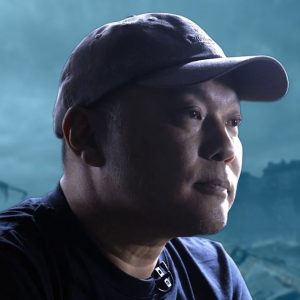
The original Dragon Quest 7 is widely considered a masterpiece. However, despite its legendary status, even those who love it most must admit it has significant flaws. One person who understands this well is Takeshi Ichikawa, the producer at Square Enix responsible for bringing Dragon Quest 7 Reimagined to market.
“When the original game came out, I was still in elementary school,” Ichikawa shared. “It was actually the first numbered Dragon Quest title I ever played.” He seems like the perfect person to lead the remake of this classic.
“But,” Ichikawa added with a sheepish smile, “because the introduction is so notoriously long, I was one of the people who actually complained and quit playing DQ7 halfway through.”
With this honest admission at the start of a long discussion about rethinking Dragon Quest 7, Ichikawa immediately shows he understands the game’s issues. When he was assigned to the Reimagined project, he played the Nintendo 3DS version of DQ7 for the first time to get up to speed. From there, with these thoughts in mind, the project began.
Streamlining the Experience
The key word here is “streamlined.” Dragon Quest 7’s greatest strength is arguably also its biggest weakness. It has a unique story structure for the series, where the narrative is told through a series of relatively enclosed stories. Events do connect into a larger world-saving plot, of course—it wouldn’t be Dragon Quest if they didn’t—but broadly, you are sailing the oceans, landing on distant islands, and experiencing a small episodic story about that island and its people. That story then resolves while also playing into a grand, overarching plot.
In a sense—and excuse me for invoking one of the true gods of the genre here—it is a little bit like Chrono Trigger. Except instead of traveling through time and learning about the dramas of each individual era, you are sailing across a broader world map. Admittedly, things do not tie together in quite as satisfying a way. DQ7 is no Chrono Trigger, to be fair, but in places it does evoke some of the same magic.
The biggest problem with the original game, though, was pacing. The game is long. Arguably far too lengthy for its own good. It is paced glacially, and in a sense shows a supreme disrespect for the player’s time and attention. Thus Ichikawa—and many others—struggled to even make it through the introduction. This core criticism of the original masterpiece and even its 3DS version remained.
“Our goal was to preserve the original atmosphere and ‘feel’ while making the experience pacey, dense, and rich,” Ichikawa explains.
“We’ve put a lot of effort into restructuring three specific areas,” the producer continues. “Visual representation, scenario, and battles.”
A New Visual Style
The new doll-like art style is the banner bearer for the visual overhaul, and it is a style many find adorable. Characters have been reimagined into cute proportions that vaguely resemble action figures. While this is something envisioned as new for Reimagined, Ichikawa is keen to point out that the new style has its roots in the game’s original art from the late, great Akira Toriyama.
“Akira Toriyama’s designs for Dragon Quest 7 have shorter, cuter proportions than the other titles,” Ichikawa notes. “We wanted a visual style that emphasized that adorable, or ‘chibi’, feel. We also saw that doll-like or puppet-inspired styles are popular in global media and felt it was a perfect fit for Toriyama’s DQ7 character designs.”
The designs are not just the work of brilliant character designers, though—the team behind Reimagined actually had real-life puppets of the characters created, which were then scanned into the development tools to create the character models. Despite the expense, this was a challenge that Square Enix encouraged Ichikawa’s team to take on.
“We believed that to get the right texture and realism, we had to physically create the dolls and scan them,” Ichikawa reveals. “It wasn’t perfectly smooth at first; when we put the scanned models in-game, there were errors and glitches with the animations that the development team had to work hard to solve.”
A visual overhaul is a vital part of the experience, but it was never a part of why Dragon Quest 7 was subject to any disparagement from fans or critics. So, while effort and expense has been put into the visual look, it is clearly reinvigorating DQ7’s pacing which has been the largest focus—and it is a topic which Ichikawa becomes more animated when engaged on.
Restructuring the Story
“The original is a series of short stories. To make the narrative easier to follow, we reordered some of these episodes. Others were changed into an optional experience, allowing players to tackle them in the order they choose,” Ichikawa notes.
“However, we didn’t just move elements around; we redesigned the scenario from scratch to find the optimum form for the storyline. To balance any cuts, we added completely new scenarios and backstory episodes to provide more depth to the characters. We worked closely with series creator Yuji Horii on every individual story to ensure we were on the right track.”
Fans will notice some storylines and entire islands have been excised from the game. But the team has clearly made a huge effort to do this with a scalpel rather than a hatchet; and rather than just cuts without further consideration, the entire game has been carefully rebalanced around these changes.
Improving the Battles
Battles are also a key part of the pace. Here is a big change: DQ7 Reimagined retains visible enemies over random encounters, a change first introduced in the 3DS version. This makes it easier to see what you are getting into, and also makes it easier to avoid encounters when you have had enough of them or need to avoid them. This, alone, is a huge game-changer.
“Because the game is so long, symbol encounters [visible enemies] are the correct decision. It gives players the choice: if you want to focus on the story, you can skip battles; if you want to grind, you can seek them out intentionally.
“Our benchmark was that minor encounters should be fast, while boss battles should be deep and tactical. For the fast-paced side, we added adjustable battle speeds, auto-battle, and the ability to cut down weak monsters on the field map without entering a battle screen,” Ichikawa expands. “For bosses, we added ‘Burst’ super attacks and the ability to ‘moonlight’ in different job combinations to add tactical depth.”
It all amounts to a lot, and with some time in a non-final preview version of Dragon Quest 7 Reimagined, one can see how these changes might actually manage to thread the needle and accomplish the near-impossible—to make a classic, albeit a flawed one, better. Too often tinkering around the edges makes bangers worse—but that does not look likely to be the case here.
“We are developing this to be the ‘Masterpiece’ version of Dragon Quest 7,” Ichikawa affirms. Soon, fans will deliver the verdict on if that goal has been achieved.
Dragon Quest 7 Reimagined is due for release on 5th February 2026 across Switch consoles, PS5, Xbox Series X/S, and PC.