I took some time to think about where Ichor fits in the work of game designer Reiner Knizia. My first idea that came to mind right away was that Knizia making a pure strategy game without a story sounds fresh. I keep my idea of a pure strategy game pretty simple. I do not call every game without a clear tale or place an abstract one. I only think of games like chess, mancala, or Santorini as abstract. In my view, these games need fixed rules, moving pieces, and a lot of thinking about space.
My next thought was that this was a silly idea. In fact, it is odd he has not made more like this. Most of Knizia’s games are abstract or at least very simple in their ideas. We could argue that all board games simplify real life, but I do not want to go there. I say no to that. Some games try to show their world in a real way. In Terraforming Mars, you gather items to make tech and build places on Mars. Other games skip that. Lost Cities is just about putting cards in order from low to high. Yet it also feels like going on digs for old treasures.
Knizia’s games often fit the second type. They simplify so much that people say he just adds stories to plain rules. He keeps saying that is not true, and I believe him about a third of the time. One thing I strongly feel about board games is that Lost Cities does a better job of making you feel like you are on a treasure hunt than many games do for their own ideas. But that is not the main point here.
The main idea is that Knizia’s games already borrow a lot from pure strategy games. This is true whether you see abstract games as narrow like I do or wide like others do. For example, is Through the Desert really abstract? His games use math, claim areas, and have very few rules. It makes sense for him to do this, and it is strange he does not have a whole set of games like the GIPF series.
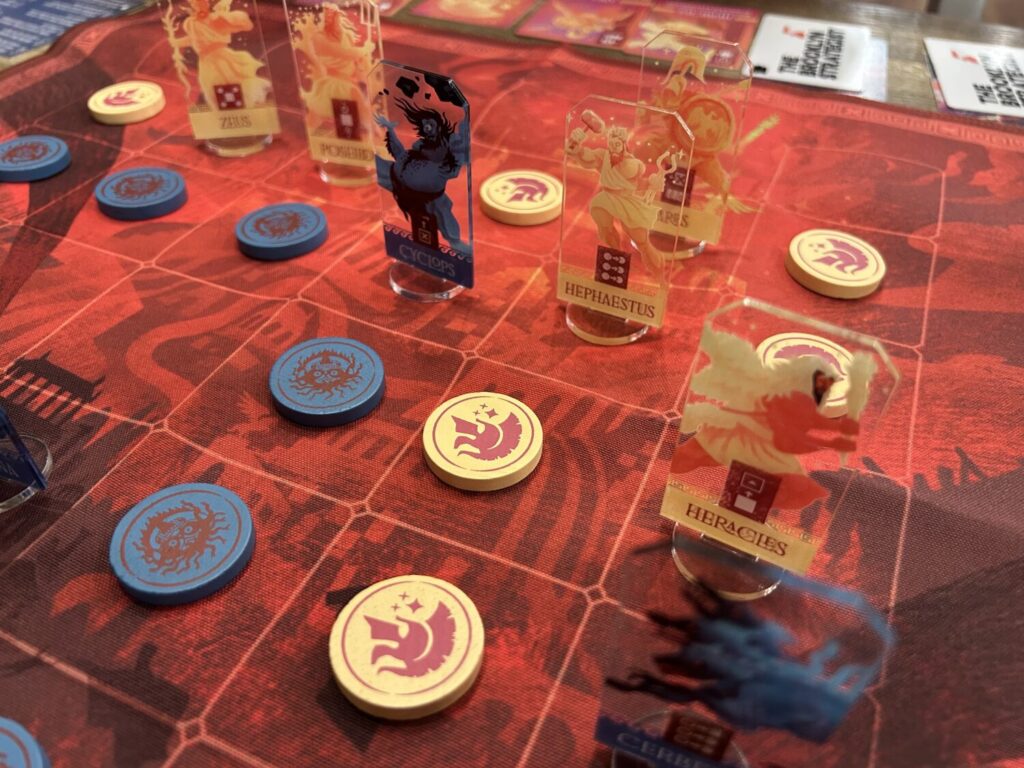
At least he has Ichor. In it, Greek gods and Greek monsters compete to place as many tokens as possible. Each side starts with six pieces on the board. Players take turns moving them straight up, down, left, or right. They stop when they choose or hit something like another piece or the board’s edge. The player places one token in each spot the piece moved through. If there was an enemy token there, it gets taken away.
Each piece has one special power that can be used only once. For instance, Artemis can move to a spot with a monster and remove both from the game. Geryon lets you put two extra tokens on a spot you just added to. Poseidon clears all tokens in his row. Things like that. I stress that these powers are for one time only because deciding when to use one of your six special moves is a big part of what makes Ichor fun.

I really like games where position matters, and I do enjoy them. But I cannot fully get into this one. It reminds me of a nice put-down from Bilbo Baggins: I like less than half of you half as well as you deserve. I can see that Ichor is a solid game with good points, but it does not click with me fully.
I think the problem comes from YINSH, one game in Kris Burm’s GIPF series. It came out first in 2003, and it is probably the most famous one. It is my top pick, though DVONN is close. You move rings on a board that feels like a hexagon. You leave and turn tokens until someone makes three lines of five connected ones. It feels lively, smart, hands-on, and worth the effort.
In YINSH, because of the way pieces move in circles, the board stays open and gets even more so as play goes on. You feel like things are moving forward, even if not always in a good way for you. Ichor, with straight moves and tight paths, is about limits. It is a slow fight to swap tokens while both try to get a small edge. The special powers of gods and monsters break those limits for a moment, and players must decide when to use them.
To me, these are like two versions from the same area of the same meal. Ichor is not different enough from YINSH, so it feels like a version that is not YINSH. When I play Ichor, I end up wanting to play YINSH more. I cannot keep the two apart in my mind. But do not let that stop you. Even if you like YINSH a lot, you might like Ichor too. If you do not like YINSH, which seems hard to believe, you might like Ichor even more. It will not become one of my favorites, but it is still a fine game.