Dewan
- Designers: Johannes Goupy, Yoann Levet
- Publisher: Space Cowboys
- Players: 2-4
- Age: 10+
- Time: 40 min
- Played with a review copy provided by the publisher
“Our land was small, and we had little to use, we moved from one camp to another looking for victory.” — A traditional song from Dewan
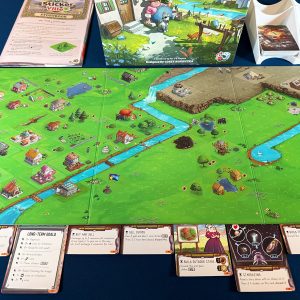
Dewan is a lively and competitive game for 2 to 4 players. In this game, you will be placing your camps on a map while racing against others. You collect terrain cards and use them to put your camps in the best spots. The goal is to fulfill the requirements on your story tiles while gathering berries and mastering fire for extra points.
To begin, set up the game by selecting a random starting tile for each player and a number of neutral tiles. Make sure to place Berry tiles correctly. You also need to choose a scenario tile that will guide the scoring at the end of the game. Each player gets a tribe board and nine camps in their color, with eight camps placed at the bottom of the board and one on the starting tile.

Next, display five story tiles above the board, with the rest forming a deck. Shuffle the terrain deck and lay out six face-up cards, giving two cards to each player as their starting hand. Choose a starting player, and then in reverse order, each player picks a story tile from the display or the top of the facedown deck to place on their board.
The game is played in turns until at least one player has placed all their camps at the end of a round. On your turn, you can either take two cards or place a camp.
When taking cards, you must choose cards that are next to each other in the display. You cannot draw from the deck. Any cards you take will be replaced with new ones from the deck. There is no limit to the number of cards you can hold, so you can always take cards.

If you decide to place a camp, pick a non-water location for your new camp and place the leftmost available camp from your board. To pay for this, you must trace a path of terrains from any of your previously placed camps, discarding a card for each terrain in that path. A single water card can cover multiple water terrains. If you pass through a hex with an opponent’s camp, they will receive the card you used for that terrain. Additionally, any card can be used to pay for the starting hex.
If the space you place your camp in has Berry tokens, you can take one. Then check your player board to see if this camp placement gives you a special ability, such as getting an extra story tile or allowing you to slide a terrain card under your board.
Story tiles help you score points. If you have placed one camp in the right spot according to your story tile, you can score that tile. You might need to have a camp in a specific color terrain or next to water or one of the three special icons found on the borders between hexes. You can also use cards placed under your board to meet these requirements. Once you complete a story tile, slide it up on your board and draw a terrain card as a bonus.

The game ends at the conclusion of a round when at least one player has placed all nine of their camps. Any unfinished story tiles are discarded. Points are scored as follows:
- Points from completed story tiles
- One point for each flame icon on story tiles and cards tucked under your board
- Four points for the player(s) with the most flame icons scored
- Four points for each group of two or more connected camps on the board
- Two points for each Berry token collected and shown on cards under the board
The player with the highest score wins, with ties broken in favor of the player holding the most terrain cards at the end of the game.
The rules also include four different variants. One is a team play scenario that creates a 2v2 competition. Each player still has their own color, but some scoring now requires pairs of camps or berries from both players. There are also three additional scenarios that change how the game is played, including a downpour scenario with water markers, a volcano scenario with lava markers, and a lake villages scenario that allows placing villages on water spaces.

My thoughts on the game
The designers of this game, Goupy and Levet, along with the publisher, made me interested in Dewan when I first saw it. The excitement from the publisher was contagious. It’s not often I fully demo a game at the press event, but the Space Cowboys team was so enthusiastic that we played through the entire game!
This has quickly become one of my favorite games from the fair. I appreciate the challenge of fulfilling story tiles. With only nine camps and three cards under your board, you must score as many story cards as possible. This means you need to find tiles that complement each other well. I often aim for cards that share components.
Luck plays a role since you must draw a new story tile with every other camp placement. Sometimes, I’ve thought about delaying a camp placement to wait for better story tiles. However, this can risk losing the chance to place a camp where I want!

The board can get crowded, and while you can save cards by staying near your camps, you might miss out on group bonuses. You earn four points for each group of two or more connected camps, so if all your camps are in one area, you only get the single four-point bonus.
This encourages you to spread out across the map, but the limited space keeps you close to your opponents. You’ll want to avoid using spaces controlled by others since they will gain the cards you used to travel there, making their next turn stronger.
There’s a lot of competition for spaces in this game, and by observing the cards other players draw, you can figure out their plans and decide if you want to beat them to a space or if they pose a threat to your strategy.

The base game is enjoyable, and I haven’t explored much beyond it yet, but I appreciate having three other scenarios to try when I want a change.
The box has a clever storage system where you can organize everything using a grid of punchboard. It works well, except for the small tokens, which I keep in a separate bag to prevent them from moving around. Overall, the organization is quite good.
Currently, I would consider this my top choice for the Kennerspiel des Jahres. It’s a well-crafted game with a straightforward turn structure, yet it provides a lot of excitement and fun in a short time.

Thoughts from other players
Doug G.: My partner and I wanted to enjoy this game, but it didn’t quite work for us with just two players. It might be better with more players, but we didn’t give it that chance.
Mark Jackson:I agree with Dale. My first impression of Dewan was that it felt like a mix of civilization building and Ticket to Ride, but after some thought, it’s more similar to Web of Power with card drafting and placing settlements. This 40-minute game offers five different scenarios, and we only played the basic one. The production quality is excellent, and it fits well into the super-filler category.
Dan B.: I enjoyed the game quite a bit with four players. I think the first scenario might get a bit repetitive after a few plays, but that’s why there are other scenarios to explore. I might end up loving it after trying the others.

Ratings from the players:
- I love it! Dale, Mark Jackson
- I like it. Dan B., Chris W, John P
- Neutral. Doug G, Ryan P
- Not for me…