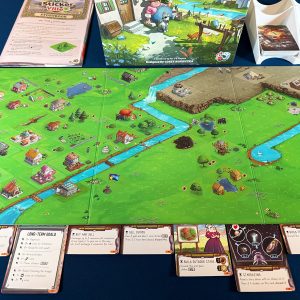
“So you’re telling me you have no otters at this zoo of yours!? Well, you’d better have something entertaining or I’m demanding my money back.”
“We have a mouse that can scare the elephants.”
“Ok, I’m back in.”

How to Run a Tiny Zoo
If you are playing the Wild Rumble version, which is the full competitive mode, take the animal card deck and deal the cards out evenly to each player. Then, make a stack of point cards depending on your player count. Put the highest point cards at the top and then go in descending order. The goal of the game is to be the first player to empty their hand of cards. Choose a first player—the rulebook says the youngest—and they take the first action.
If there are no cards on the table, which there won’t be on the first turn, you take a Lead Action. Here, you simply play any number of cards of the same animal type onto the table. The next player can either Pursue or Pass. There are two ways you can Pursue. You can play the same species as the previous player but with exactly one more card. The other way is to outrank them. Each animal has a bubble above them with any number of other animals that will outrank them. To outrank an animal, you need to play exactly the same number of cards that were played but of an outranking animal.
There are also two special types of cards: the chameleon, which is a wild card, and the mosquito. The mosquito can be played as its own set, or you can add exactly one to a set of elephants to act as an elephant.

If you play a set of cards and the turn gets back to you and they haven’t been beaten, then you take all the cards that have been previously played and put them next to you. You then get to take your turn by taking a Lead Action.
When a player empties their hand of cards, they take the next highest point card from the stack. Play keeps going until all but one player has run out of cards. The player with the most points wins. You can either end the game there or play 3 to 5 rounds and total up your scores from all the rounds to determine the winner.
The Team Rumble
There’s also a team rumble which you can either play on its own or after you’ve played one round of the Wild Rumble. The round of Wild Rumble will be a factor in deciding random teams based on your score in that game. You could, of course, play without that and just pick your teams. The difference is that the Wild Rumble could serve as a sort of practice round for new players.

The team rumble involves having teams of two, each with a junior and a senior per team. This relates to roles you play in the team, not the ages of the players. At the start of the round, teammates can swap two cards with each other. On the junior player’s turn, they can ask for help when taking a Pursue action in which you don’t have enough cards to beat the previous play. They play the cards they have, and the senior player can add cards to that hand if they’ve got them (and if they want to). If not, the junior takes their cards back and passes.
When someone goes out, both they and their teammate take the top card of the stack. At the end of the round, add up your points cards. Then, each player that has at least two lions in their stack will score 1 point per lion. You lose a point if you have no hedgehogs in your stack. If you’re the last player with cards in your hand, then you lose 1 point per lion in your hand.
The Old Zoo
Frank’s Zoo has been knocking around since 1999, so with this new version, it’s worth assuming that if it’s been around for 26 years, there must be a reason, right? Well, maybe, but I’m not sure I’m the best person to tell you what that is. Yeah, spoilers, I’m not exactly in love with it. I’ve played this with a few different groups, and it’s not really been a hit for any of them. That’s not to say that this is a terrible game by any means, and in fact, if you look at the reviews on Board Game Geek, I definitely skew in the minority. So, all I can do here is tell you why it’s not for me. You never know, the things I didn’t like may well be exactly what you’re looking for in a game like this.

The Wild Rumble mode is the big letdown for me because how well you do is down to the cards you’re given. There’s no starting hand mitigation, no ways to mess with your cards during the game, and no real ways to make a truly clever strategy to make the best of it. It can make or break your game, and you can generally guess how your game is gonna go just by looking at that opening hand. It becomes frustrating when you find yourself constantly saying ‘pass’ not from any strategic standpoint, but because you’ve got no choice. It leaves a bitter taste in your mouth.
There may be some strategy in not playing cards when you can. Maybe if you need three cards to beat something but you have four of that animal in your hand, then I can see the logic in holding back until you can play all of them. It’s a very light strategy and a bit of a gamble to sit on since the opportunity to shed all of those cards at once may not even present itself. Plus, you don’t really want cards to loop back to the original player for them to take a lead action to shed yet more cards from their hand. Don’t get me wrong, I don’t expect light card games like this to have a ton of strategic depth. In fact, there are a lot of great games out there that are just as strategy-light as this, and I love them for it because they’re just fun. Unfortunately, this mode just lacks the fun aspect for me.
My other frustration is the insistence in the rules that if you win a stack, you take it into a personal pile. But then when it comes to scoring, nothing is done with it. It seems like a minor gripe, but I had to keep checking the rules because people kept asking the relevance of it, and I thought I’d missed the reasoning behind it. This rule comes into play in the team rumble mode and has a scoring purpose, so maybe it’s setting some good practice for that, but it would have been nice to at least have let us know that.
A Second Chance?
After one game of Wild Rumble, you can either set up for another round and play maybe 3 to 5 rounds and see who has the high score or leave it there (my groups decided the latter of those two options), or you could play the team rumble, and this is where the game kinda redeems itself.
A lot of the things that are lacking in the Wild Rumble have some fixes in the team rumble. There’s now some form of mitigation since you can pass cards between teammates. The junior passes two, then the senior passes two back, and it makes for a touch of mitigation that may be invaluable during the game, and it gives teammates a bit of foreknowledge of at least a few of the cards in their teammate’s hand. Being able to help a teammate is a nice addition as well and could help you get out of some scrapes, especially on an important play. However, I do find it a bit weird that only the senior can help the junior and not the other way around as well. It’s like the game is trying to help mitigate those less than stellar hands of cards but then immediately throws in a twist at the same time to mess that up.
The scoring is the thing that adds some meat to this variant, though. Just by making the cards in those stacks you win important opens up a lot more opportunities for strategic play. Now holding back cards and voluntary passing makes more sense as you wait for a stack to populate with some of the juicier cards before you unleash that big play to win it. Choosing to pass rather than beating a hand may even push another player to win a less than stellar stack, and I’ve gotta say, it’s kinda satisfying when that happens.