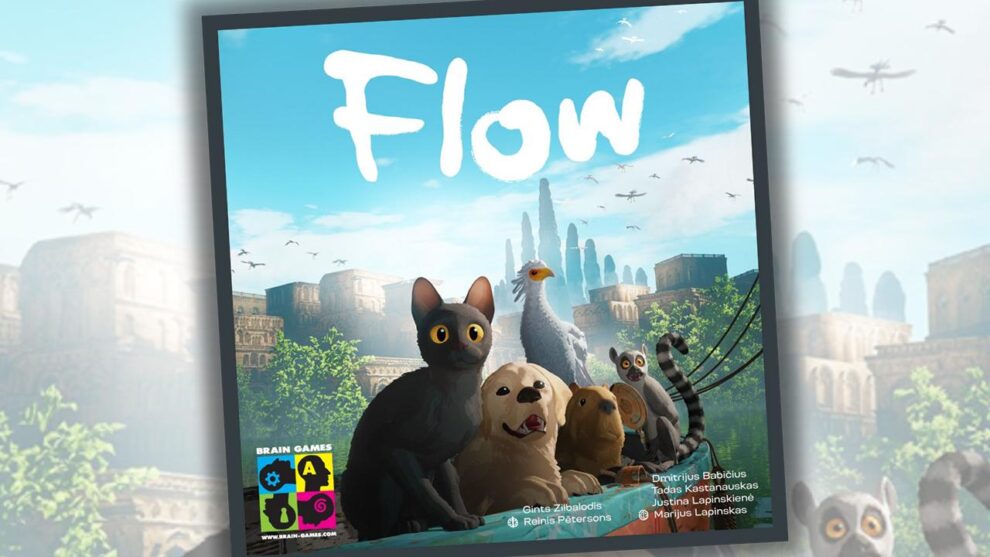
The world is under water, and the animals need your help to stay alive. Learn how you can help out in this look at Flow.
The animated film Flow came out in 2024. It tells the story of a group of different animals working together to get through a huge flood that feels like the end of the world. The board game Flow, which came out in 2025, takes a lot from that story. It’s a team game where everyone works together. Players hurry to place pieces that make paths. These paths help animals stuck at the board’s edges reach the safe boat in the center. Every minute, when the timer ends, you roll dice. Based on what comes up, some pieces get swept away by the flood. This makes players start over in those spots. If you make paths for all four animals, your team wins. But if you use up all the pieces first without finishing, you lose.
Overview
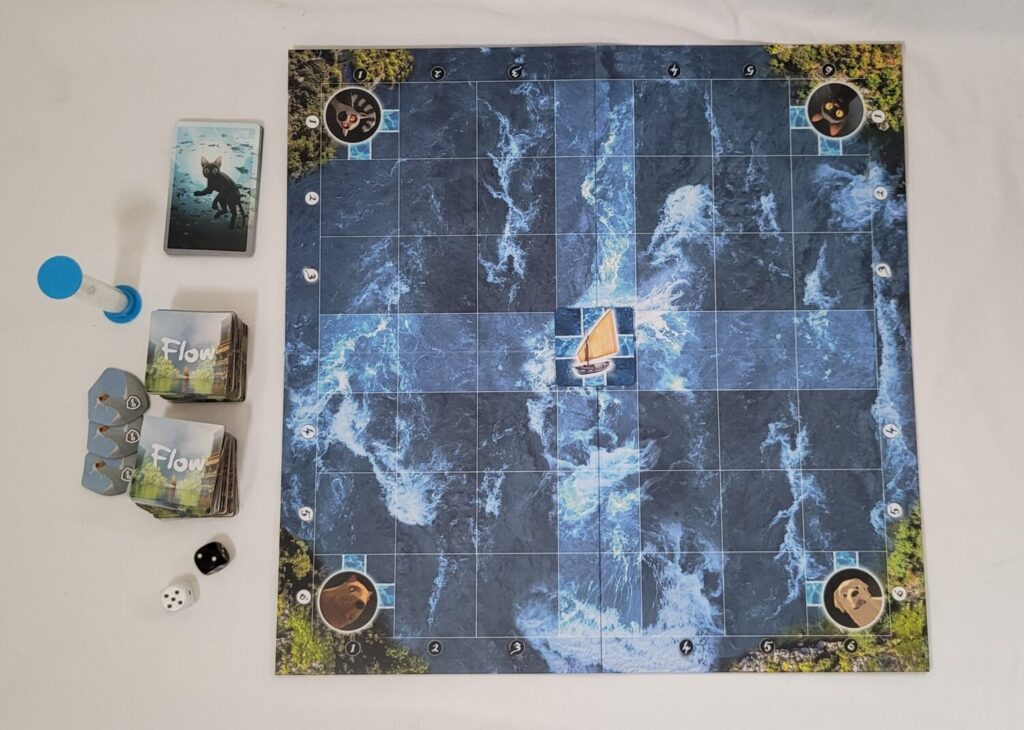
The board is a grid that’s 7 rows by 7 columns. In each corner, there’s a picture of one of the four animals you need to save. Each picture starts with two path beginnings coming from it. The middle row and middle column stand out in a different color from the other empty spots. When setting up, you put the boat piece right in the middle where those lines cross. The boat piece has two sides. One side shows the boat with four paths leading in. The game suggests using this side for your first games. You can turn it over to the harder side later. That side has just one path into the boat.
Every path piece shows a part of a path. Some are straight lines, some are crosses, and some turn at right angles. The goal is to connect these pieces to make a way from each animal to the boat. At first, it seems simple. But that timer I talked about? It will make things tough for you.
Starting with the first player, everyone takes turns pulling path pieces from stacks that are face down. These stacks are made during setup. Players place the pieces on the board to build the paths. But before anyone draws the first piece, you start the one-minute timer. When it stops, everyone pauses. Then you roll two dice. One die picks a row out of the six outer ones, and the other picks a column. The middle row and column are safe, which is why they have a different color. The tiles in the chosen row get removed, like the flood took them. The same happens for the chosen column.
If you’re lucky, the dice pick empty spots or areas with few pieces. That way, you lose only one or two. But luck doesn’t always help. The flood comes and takes away what you built. You have to start building again. Early on, with lots of pieces left, it’s not too bad. But near the end, with only about 10 pieces, losing six can set you back a lot. If you run out without all paths done, the game ends in loss.

When I played Flow, I saw both good and bad luck. Some games we lost because the flood hit at the wrong time and we ran out of pieces. Other times, the flood didn’t hurt much. Most often, it was the second kind. Maybe it was luck, or maybe we spread out our pieces to avoid big losses. I think it’s both. Even with luck playing a big role, good moves get rewarded. And you aren’t totally up to chance. There’s something else: the action cards.
Action Cards
There are 15 action cards in all, with six types of actions. At setup, players get some of these. On your turn, instead of drawing and placing a path piece, you can use an action card. When you do, it gives a big help that changes the game. For example, the Calm Waters card means you roll only one die when the timer ends, not two. The Bird card lets you put a bird marker on a piece. That saves it from one flood. If you need more action cards later, you can throw away the path piece you drew and take an action card instead.
These cards work well if used at the right time. But I saw my 7-year-old son have trouble understanding what each card does. He used them whenever he felt like it, not always when it helped the team most. I could have told him the best times to use them, since it’s a team game with a kid. But I like letting him choose, even if it’s not perfect. That way, he learns from what goes wrong. Parents of young kids should know this. The words on the cards are simple, but figuring out when to use them might not be easy.
After a few plays, if the game feels too same, you can add scenario cards from the box. These change things by adding blocks you can’t pass or rules that limit you. For example, the No New Cards scenario stops you from trading pieces for extra action cards. The No Communication one lets you talk only when rolling the flood dice. The more scenarios you add, the harder it gets.
I haven’t tried these yet, since I mostly play with my son. The action cards already make it challenging enough. Adding more to make it tougher would take away the fun. Flow works great on its own. It moves at a good speed so no one gets bored. It’s simple to learn in a few minutes. Games don’t last too long. And it’s hard enough to keep kids and grown-ups interested the same way.