“Daddy, I’ll be honest…this one is a negative 0.5 for me.”
Those were the words from my nine-year-old son right after we finished our first round of Deep Dreams, a new compact card game from Devir. My son is a kid who loves critiquing games just as much as he loves judging every restaurant we walk into. The game’s rulebook explains that little Bruno has gone to bed and is now traveling through the land of dreams. Players hold a hand of cards that show the path Bruno takes during his sleep journey. The cards feature pictures of Bruno in bed and various arrows that must be lined up to create a continuous path for his sleep cycle.
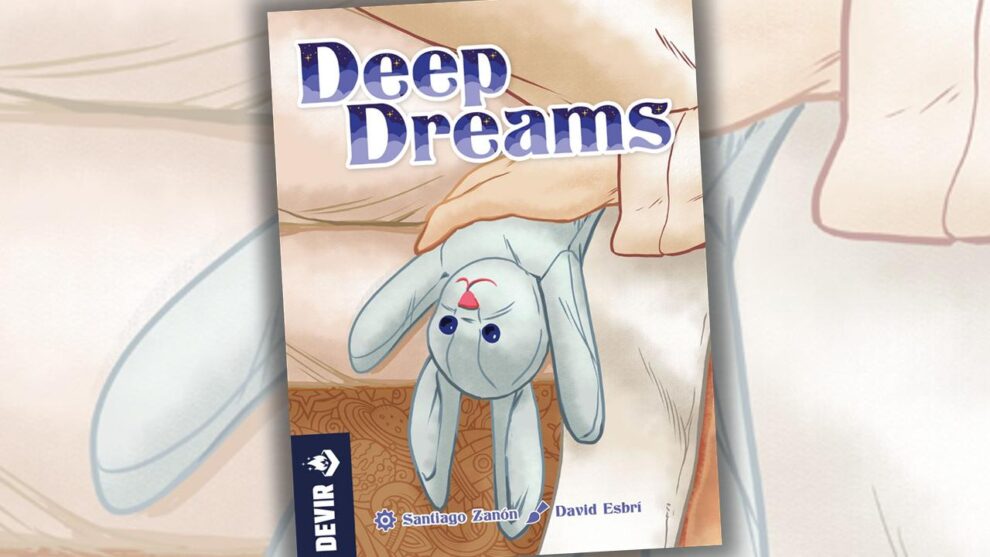
It sounded like an interesting concept when I read about it. When I taught the game to my son, he seemed interested at first. The box has a cute picture of Bruno’s hand holding a fluffy bunny rabbit, with just a bit of it sticking out from under the bedsheets. However, things changed fast. The first time the game allowed me to steal one of my son’s cards, and then again when I got the chance to remove cards from his play area, his enthusiasm faded quickly.
“Oh… it’s THAT kind of game,” you might be thinking.
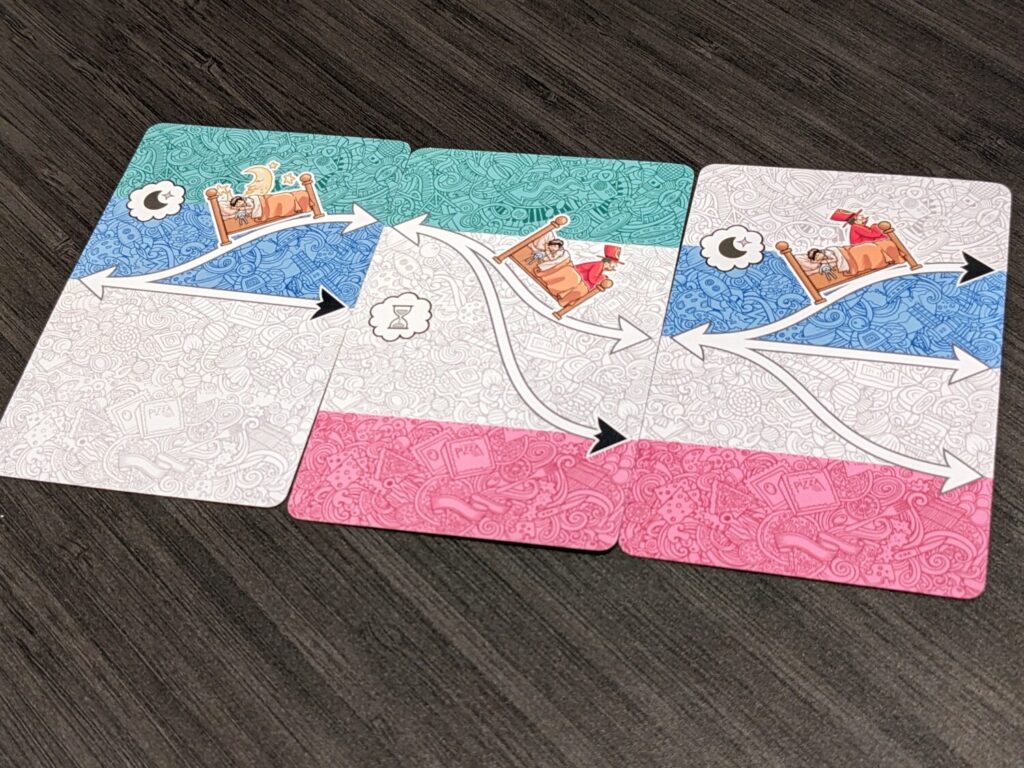
And yes, Deep Dreams is exactly that type of game. It is a somewhat aggressive race to score the most points by simply playing cards onto the table. Depending on the number of players, the game ends when someone has placed 10 cards on the table, or after everyone has had an equal number of turns. Points are earned by creating “Dream Groups,” which means placing cards that match the same color scheme. Each card displays colors in different zones and in a different order. It is also important to align the arrows running along the middle of the cards to keep Bruno on the same “Sleep Path.”
This makes Deep Dreams easy to teach and easy to score. However, the game’s short runtime of 10 to 15 minutes never really got the players excited. Sometimes, turns end without a player playing a card at all. Because there is no hand limit, my son found himself in a tricky situation during our first game. He was trying to build off his starting card but couldn’t find the right cards to match the colors as his hand grew larger and larger.

“Hey buddy,” I started. “Just a reminder that the game is going to end after one of us plays 10 cards… and I already have seven cards on the table!”
“I know, I know, but I want to play the right card,” he said. “The arrows will line up, but I won’t score enough points with the colors.”
I actually liked the card play in Deep Dreams, especially the icon effects that changed up the gameplay, even if my son did not. You can really mess with other players in this game. That is fine in a title that plays so quickly, assuming you are okay with your dreams being dashed when people like me steal your cards!
Or maybe I liked Deep Dreams more when I was the one stealing cards from opponents or wrecking their tableaus. In fact, the seven icon effects let players break some rules, cover previously played cards, look at the top three cards of the draw deck, or double a card’s value in a Dream Group during final scoring.
Either way, Deep Dreams isn’t terribly, well, deep. As a family-weight game that plays fast, Deep Dreams was just OK. The strength of Devir’s extensive catalog lies elsewhere.