Vineyard might have the strangest theme mismatch of any game I have played this year. At first glance, it looks like a friendly competition between winemakers trying to produce the best merlot. However, if you look closer, you realize that all the players actually own the same vineyard. They are competing against each other to make the best wine from a shared property. But it goes even further than that. The players do not actually own the vineyard at all. It is owned by four non-player characters called “friends.” The players share control of these friends to do the work. The goal is to win acclaim for wine that everyone helped make together. Players can also upgrade actions for different friends. This means each friend is better at specific tasks, but only when a certain player is helping them.
I usually do not get too hung up on theme in games. However, the mechanics in Vineyard feel more like a game about the Cold War than a relaxing game about crushing grapes. This confused me every time I set it up. It was definitely not a good first impression. I have changed my mind about games with weird themes before, so I wondered if Vineyard could do the same.

Vineyard is a worker-movement game for one to four players. A typical game takes about 60 minutes to finish.
Gameplay Overview
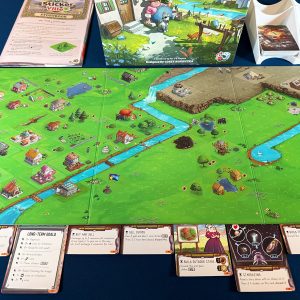
Vineyard is a game about making wine. On your turn, you play a card from your hand into an open column on your player board. Each column corresponds to one of the four friends working in the vineyard. You then move the relevant friend to the action space shown on the card. Finally, you take that action.

Five of the seven actions in the game relate directly to the winemaking process. These include harvesting and cultivating grapes, making and aging wine, and loading aged wine barrels onto a truck. Each time you take one of these actions, you place heart tokens on the output of that action. As wine moves further along in the production process, more hearts accumulate. These hearts score points for their respective player when the wine is finally loaded onto a truck.
The other two actions in the game are more administrative. The Greet action lets you take a visitor card and gain its one-time benefits. The Paperwork action has you pick up all your previously played cards for a reward. You can then spend your earnings on upgrades. The columns on your player board can be upgraded to make a specific action stronger when you use a specific friend. A randomized shop of action cards lets you swap out your initial cards for more powerful ones. These new cards might let you take multiple actions in a turn or gain extra benefits.

The game ends once three trucks have been fully loaded with wine. The player with the most points at this point is the winner.
Game Experience
On paper, Vineyard has some good ideas. Chaining different action cards to different friends to make your actions as efficient as possible is a neat puzzle. There is also a potentially interesting semi-cooperative undercurrent to spice things up. You can use the work of other players for your own benefit, but that player will also reap some benefits when the resulting wine is finally loaded. The action upgrades also push players into their own play style, leading to more asymmetry over the course of the game. Unfortunately, Vineyard is kind of a drag to actually play. None of its elements feel as interesting as I thought they would be. The overall experience is less than the sum of its already underwhelming parts.

The card play, for example, never leads to much interesting decision-making. You are occasionally stymied by the inopportune placement of a specific friend at a specific action. However, you can almost always accomplish what you want with only a minor inconvenience. It lacks the agonizing tension of a good worker placement game. It also does not provide the head-scratching pleasure of an in-depth management game.
Your available actions are also bland. Every wine-making action provides you with similar amounts of points in the end. This makes each one feel indistinguishable from the others. Actions feel more or less the same without any satisfaction of a clever play. This renders the entire procedure a chore rather than a challenge. While in theory, players are helping each other by utilizing their grapes or wines in their actions, in reality, this feels less like cooperation and more like accidental arbitrage. I never helped another player unless I had no other option. Players never felt compelled to take actions that would incentivize me to help them.

Despite rattling along at a reasonable clip, Vineyard feels much longer than it is due to its lack of texture. Turns never feel particularly good or bad. The game never changes due to its own enforced three-part structure. After each truck is fully loaded, new wine barrels and visitor cards are drawn from a different deck. These have more stringent requirements and tantalizing rewards. The game gets harder as players get stronger, but it does not get much more complex. This makes the game feel stagnant.
Final Thoughts
My thoughts on Vineyard can be fully captured by a resigned shrug and the word “Meh.” Nothing about the game is broken or unbalanced. It certainly looks nice on the table. However, at no point did I ever feel excited, or tense, or even angry. My friends and I simply sat at a table for an hour moving pieces. By the end, we were already forgetting this game existed.
Final Score: 2.5 Stars – A technically competent game that I do not ever see myself wanting to play.
Hits:
• Good production values
• Some theoretically interesting mechanisms
Misses:
• Actions are repetitive and uninteresting
• Game feels longer than it is
• No sense of tension or challenge
• Lack of replay value