My friends in our Wednesday gaming group recently decided to do something different. Instead of always opening the newest games still in their shrink wrap, we wanted to look at the older titles. These are the games sitting at the bottom of our shelves, covered in a bit of dust. The idea was simple: let’s figure out why we kept these old games when we rarely play them anymore. Right there, we created the Dusty Euro Series. I have asked other game groups to join me in looking back at these older titles.
To share what we find, I will write about games that are at least ten years old. We have not reviewed these games here before, so this is a fresh look. These articles are not full reviews. I will not explain every rule or give a long introduction to the game. Instead, I will share my quick thoughts based on playing the game one or two times recently.
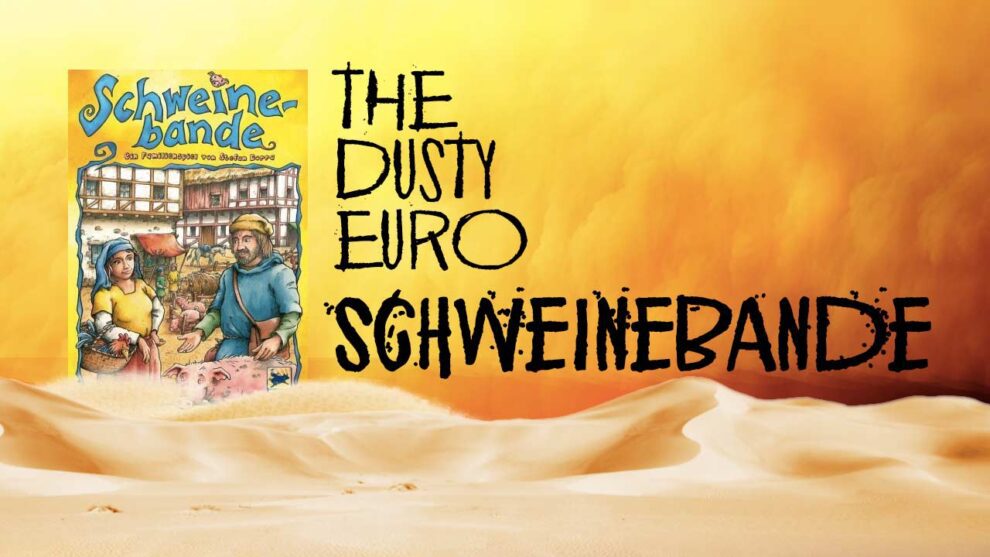
Schweinebande: What Is It?
Schweinebande is a German word that means “gang of pigs.” It is a game about collecting sets of animals for two to five players. To be honest, Schweinebande is a strange game. The cover art is funny, but the pig in the bottom corner of the box looks a little scary.
Fortunately, the game itself is easy to understand. Players use three farmer pieces to claim spaces on a small, diamond-shaped map. This map represents a cattle market. As players flip tiles, donkeys, chickens, goats, and pigs are slowly revealed. The goal is to collect as many animal tiles as you can. When you get four of the same animal, you secure them to score points at the end of the game. You also have to feed your animals, but there is a fun twist. You can use animal tokens of one type to feed animals of another type, so feeding them is not too difficult. One type of token is actually a feed bag. You can burn this bag to feed all your unscored animals in one round.
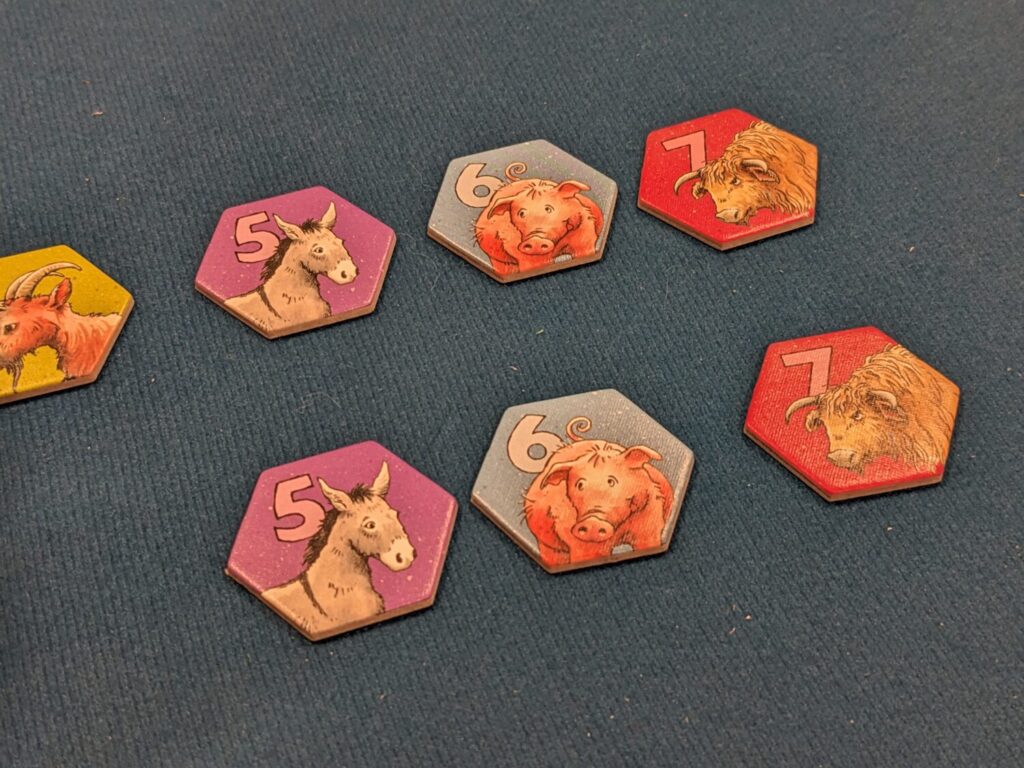
Scoring at the end of the game is quick. Players add up the values of the tokens they collected. These values range from 2 to 7 points each. Chickens are worth the least, while cows are worth 7 points. If there is a tie, the player with the most pig tokens wins. That seems fitting for a game called Schweinebande.
Everything is An Auction
I am not going to rush out and tell everyone to hunt down a copy of Schweinebande. It was a good game, but it is not essential. However, for a game that takes about 30 minutes to play and has funny animal art, Schweinebande is worth a look.

The main attraction is how the tiles are revealed. Before players commit a meeple to a space, they can see what tiles are available. Placing a meeple lets you capture tiles in one direction, starting from the meeple and going to the edge of the map. Other players can block you, and since tiles run in different directions, it is fun to watch players position their meeples. They try to grab the tiles they need while also messing up their opponents.
There is another interesting rule: the player who places all their meeples first gets to remove them first during the scoring phase. This ensures they can get the most tiles. The downside is that if you commit your workers too early, you let other players flip more tiles. This helps them see exactly where to place their own meeples to grab the best tiles.
I played a three-player game of Schweinebande and liked what I saw. A couple of weeks later, my friends hosted a game day where we only played games from the publisher Hans im Gluck. A five-player game of Schweinebande followed. I think the five-player game is probably the best way to play. With five players, there is enough chaos to match the theme of hauling in pig tokens to win the game.