J.D.: This is a broad question. But for the unfamiliar, the key is to understand with my designs are that the FW, BW, and TW game scale is specifically designed to model not aircraft flight, per se, but what a fighter pilot can reasonably accomplish in what is known as a standard “OODA” loop cycle. Whether you were a fighter pilot flying Sopwiths in WW-1, or jet aircraft in the Korean War, forty years later, the one thing that hasn’t changed, is the “OODA” cycle. “OODA” stands for “Observe-Orient-Decide-Act”. It’s an actual mental process, first recognized and codified by Eric Hartmann, the most famous and successful German fighter pilot on the Russian front in WW-2. It has been taught at Top Gun and the USAF Fighter Weapons School, but under different names. You will often hear or read about the term “Situational Awareness” or SA. Guess what, SA is derived by OODA looping. In short, the OODA loop works this way – it’s a four second cycle, on average – and it is a continuous never ending loop, constantly changing, evolving, and getting modified as the fighter pilot maneuvers his way through a life and death air battle. It takes about one second of visual inputs, for a pilot to OBSERVE as much as he can. It then takes another second of time for the pilot to interpret and sort all the visual, aural and physical forces information assaulting his eyes brain and body to ORIENT himself to his situation. Based on that orientation, the pilot must then DECIDE what to do to attack or defend himself (about a one second process) and then the fourth second is taken up with the ACT of placing the aircraft controls in a position to start moving the airplane where he needs it to go. As his fighter’s flight path starts to change, he will be observing the changes, and reorienting to the changes etc. It should be understood that the OODA cycle in not sequential in nature. You don’t Observe-Orient-Decide-Act and then start over. It’s layered, each piece responsible for starting another cycle. Kind of like how a staggered “Row-row-row the boat song is sung.” As the OODA cycle progresses each piece is being observed by the pilot for its effects and that requires Orienting anew, deciding anew, Acting…etc.
Observe Orient Decide Act <<< OODA cycle 1
Observe Orient Decide Act <<< OODA cycle 2
Observe Orient Decide ACT <<< etc.
Grant: What is your design goal with the game?
J.D.: Quite simply, to immerse the gamer into the accurate historical context of the Far East Air Campaign as fought in 1941 and 1942 and let him have some fun, while flailing about the map board solving the situations he himself creates while moving his aircraft in plane-on-plane tactical air combat.
Grant: Who is your developer Terry Simo? What does he bring to the design?
J.D.: I’m proud to say that Terry is one of my great life-long friends, a fellow Military Aviator, and he brings to the design his own instincts as a successful air game designer himself, having developed and even published his own air combat designs with GMT Games. With regards to rules balance, scenario play balance and a critical eye for ensuring that a “non-pilot” gamer that has never had any flight instruction will be able to understand the rules concepts put forth by myself to fly in the game – Terry has been invaluable. I can’t thank him enough for his efforts. BTW Terry and I met back in the late 1980’s during my jet combat game design era and he’s also been a life long Fighting Wings System player since that series was first published.
Grant: What was unique about aerial combat in the CBI Theater of WWII? How did you model this?
J.D.: Technically, Tiger Wings covers more than the CBI (China-Burma-India) theater. It covers the air fighting over Malaya, Sumatra, Java, the Philippines etc., with Burma, being just one portion. My approach to the game scenarios that is unique is to try to explore both the reasons for the many Allied failures and their few successes in these campaigns, in terms of highlighting what the tactical errors were and how the successful flyers, such as the Flying Tiger pilots were different in their approach to fighting the Japanese.
Grant: What various planes are included in the game? What is unique about their statistics?
J.D.: Tiger Wings has an eclectic and fun group of early warplanes to push around. On the Allied side for fighters, there is the Hawk 75, Brewster Buffalo, Curtiss Wright Demon, Hawker Hurricane, the Curtiss P-40 Tomahawk and the P-40E Warhawk. The Japanese Army Air Force pretty much only has Ki.27 obsolete fixed gear Nates and the newer Ki.43 Oscar fighter to work with, while the Imperial Japanese Navy shows up with the outstanding A6M2 Zero fighter. For the most part, all of the Japanese fighters are agile, but fragile, and woefully under-armed, except for the Zero. Almost all of the Allied fighters are much more robust, armored and well armed, and even faster than the Japanese planes, yet they were still defeated in detail by the Japanese flyers, and the reason goes to the use of good tactics by the Japanese and bad tactics by the Allies, exacerbated by the very poor experience and training levels of the Allied pilots facing the Japanese veterans of the air war in China.
Grant: What is the anatomy of the counters? What information is included?
J.D.: Each aircraft counter in the game represents a single aircraft. It will have a top view, a type name and an ID number and nothing else. Everything else about the fighter’s performance is kept noted on an aircraft log sheet, since the aircraft’s pitch angle, bank angle, speed and height can constantly change during play. All of the aircraft’s performance capabilities at different altitudes is summarized on each aircraft’s data card, known as an ADC. Here is a sneak preview of the Dutch CW-21 Demon fighter.
Grant: What information is included on the Aircraft Data Cards?
J.D.: As you can see from the Demon Aircraft Data Card example, everything you need to fly the plane on the game map is summarized on the Aircraft Data Card. For different altitude bands, each about 6,000 feet thick, there is a listed minimum level speed, maximum level speed and maximum safe diving speed and the numbers are in terms of “Hexes of movement”. So if an aircraft has a current speed of 6.0, it can move six hexes in a game turn. Each point of speed equals 50mph of scale speed, so Speed 6.0 equals 300 mph of speed, and so on.
Grant: How does combat work in the design?
J.D.: In the FW, BW and TW game system, standard war game odds tables are used along with a percentile die roll to resolve combat. Aircraft firepower diminishes with range, reflecting a loss of accuracy as range increases, and aircraft have a defense factor, which is increased by the angle of deflection of the attacker, to reflect the increased difficulty of a hitting a target from the side as opposed to from the rear. Ideally, the best shots occur if the attacker is directly behind the target with no deflection shooting required and at a close range. Damage is inflicted in terms of “hits” with multiple hits sometimes resulting in special “critical damage” events such as causing an aircraft to lose its wings or explode from a fuel tank hit. The combat system is one of the most popular parts of the entire series often creating entertaining story telling as you play. “There I was, wing on fire, engine sputtering, pilot wounded…. And so on”.
Grant: What do you feel the game models well?
J.D.: Obviously I’m biased. It models how three-dimensional maneuvering impacts a dogfight’s overall geometry very well. There is a good reason to attack from above in a dive, because of the extra energy you’ll get from diving, and thus the extra speed, that may well then let you zoom out of a bad situation. Speed is life. Get slow…not good, you can stall and spin out if that happens in the game.
Grant: What has been the experience of your playtesters?
J.D.: Terry and I ran two different groups of playtesters through the rules and through multiple varieties of scenarios. In Terry’s group there were two players who had never played a FW or BW game before. They did fine. We also had experienced Fighting Wings players who – obviously had no issues with the beginner version rules. As far as I can tell, the playtesters, themselves, were entertained by the process. A good sign.
Grant: What are you most pleased about with the design?
J.D.: The beauty of the game counters, and the game map, thanks to the fantastic talent of our counter Artist, Ian Wedge from England and our map artist, David Friedrichs from the USA.
Grant: What other designs are you contemplating or already working on?
J.D.: None at the moment, my plate is full, but on my to-do list…I’m contemplating how to best do a WW-I air combat game design.
Well, gentlemen, thank you so much for letting me blab a bit about this new product. I hope this will provide some interesting insights for your readers.
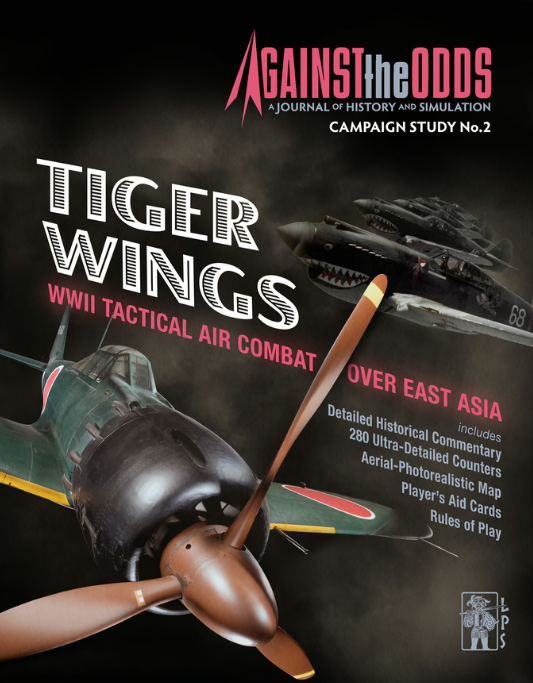
Thank you J.D.! It was a pleasure getting to know you a bit and we appreciate you doing this little interview on such short notice. Good luck with the Kickstarter!
If you are interested in Tiger Wings: WWII Tactical Air Combat Over East Asia in Against the Odds Magazine Campaign Study No. 2, you can back the project at the Kickstarter page.