In Portugal, there are special restaurants where you can enjoy traditional food while listening to fado music. This music style started in Lisbon in the 1820s. It usually has sad melodies and lyrics about the sea or the lives of poor people. The music carries feelings of resignation, fate, and melancholy. People often spend their whole evening in these places, called “House of Fado.” They eat and listen to music that speaks about “saudade,” a Portuguese word for longing or missing someone. Once you sit down at a table, you usually stay until the restaurant closes.
Traditional fado music is played by three musicians. One plays the Portuguese Guitar, which has twelve strings. Another is the singer, known as a “fadista.” The third plays the Viola de Fado, a classical guitar. The Portuguese guitar has a special sound, and its chords are played differently than the classical guitar.

The board game House of Fado puts you in charge of one of these restaurants. Your goal is to manage the place, attract customers, and hire musicians. By doing this well, you gain prestige for your fado house. You will move your staff members around to perform different actions. This uses a special mechanic where you can bump other players’ pieces off spaces, similar to the game The Gallerist.
Setting Up the Game
First, you need to set up the board. Place the musician tiles, Notation tiles, and Fado tiles in their correct spots. Put customer meeples into a bag: use two grey, three black, and four brown for each player. Randomly draw these and place them above the three bottom locations on the board.

Each player gets a restaurant board in their color and all the matching pieces. The spaces on the Prestige track at the bottom of the board start covered with cubes. Every player begins with three workers placed next to their restaurant board.
How to Play
The game is played in turns. On your turn, you place one of your workers on any of the seven action spaces on the main board or on the action space on your personal restaurant board. During the first three turns, you place a new worker that started next to your board. After that, you must move a worker you already placed to a new valid location.

If you place your worker on a space that already has an opponent’s worker, that opponent’s piece is moved to a free “Kick-out” space. The opponent immediately gets the benefit of the space their worker was moved to. If there are multiple Kick-out spaces available, the player whose piece was moved gets to choose which space to go to. Note that you cannot kick out your own worker, and you cannot place a worker on an action space if you already have a worker in one of the Kick-out spaces for that action.
The Action Locations
There are five main places where you can put a worker. Each has its own rules.
1. Musician Market
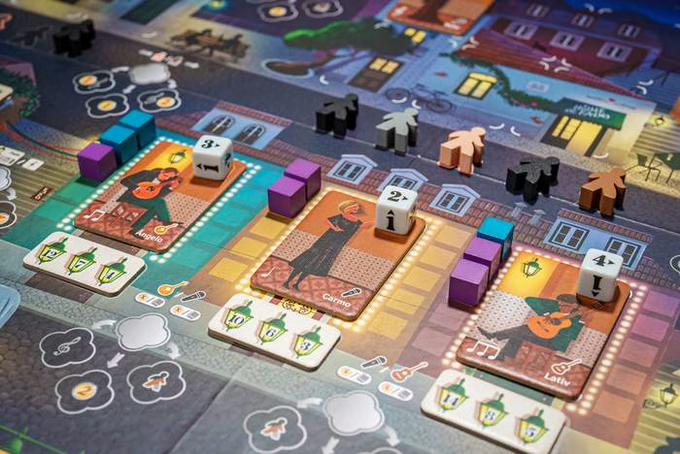
There are two worker spots here. Place your meeple in either spot. Then, choose up to one tile from the group on the left and up to one tile from the group on the right. The cost of each tile is the sum of the modifier printed on the board and the number from the chart on your restaurant board. This depends on the Fame level of the tile. If there is no die on your tile when you buy it, place a “1” die on it. Put the tile on your restaurant board and take the matching Notation tile for the bottom of your board. You can only have one musician of each type. You have preprinted resident musicians on your board, but you can replace them with new tiles. If you are kicked out of this space, you can choose to take money or add customers to the bar area of your restaurant.
2. Street
Here, you can add Customers or a Critic to one of your tables. Customers are placed at a single empty table. You start with two tables but can unlock a third if you move far enough on the Prestige track. Customers earn you money and provide Applause, which increases your musicians’ fame. To get a Critic, you pay a fee based on your progress on the Prestige track. A Critic takes up a whole table by itself and does not give applause or pay for food. If you are kicked out here, you can take money or add a Notation tile to your restaurant board.
3. Rehearsal Room
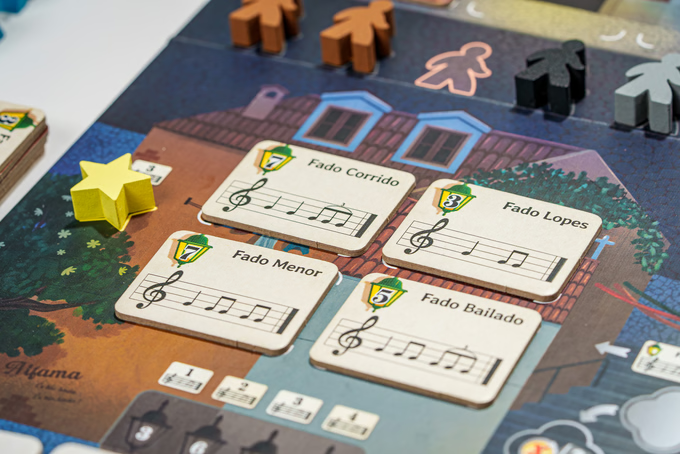
You can either take a Notation tile or write music to score one of the four Fado tiles on display. To score a Fado tile, you must discard Notation tiles as shown on the Fado tile. You then score the victory points shown on the tile and place it on your restaurant board. If you are the first player to have three Fado tiles, you gain the Star for that area. If you are kicked out here, you can gain money or pay to increase the fame of one of your musician tiles.
4. Billboard
You can promote a musician or contract a renowned musician. To promote someone, the musician must have a Fame of at least 2. Take the tile from your restaurant board and place it on the appropriate space. The fame level must be higher than the musician currently on that space. The less famous musician returns to the market with its die. Take the leftmost Prestige cube from your track and place it on the track of the Billboard space you are using. Score points equal to the number on the die of the newly placed musician. Alternatively, you can hire a musician from the spaces here, paying a cost shown on your restaurant board chart based on the musician’s fame level. There are two action spaces here, and each only lets you access two of the three possible sites. If you get kicked out here, you can choose money, a customer, or a Notation tile.

5. Restaurant Board
Each player has an action space on their own restaurant board. Placing a worker here means you are closing your restaurant for the night. Each customer pays you a fee based on your current Prestige track standing. As they applaud, you can use them to increase the fame of your musicians. The number of customers needed to increase Fame is shown on the chart in the upper left of your restaurant board. Note that each type of musician can only use certain types of customers to increase their fame. If you have the first musician of any type to reach Fame 6, you move that musician to the Famous area of the main board and take the star token beneath it. You also immediately score 6 points. Now, decide whether to keep your musicians. If you dismiss one, return it to the appropriate Market area with its die unchanged, and score points equal to its die value. If you have a critic in your restaurant, return it to the board and remove two Prestige cubes from your prestige track. If you are the first player to remove all their cubes from the Prestige track, you earn the star for this feat. Finally, discard all the customers in your restaurant.
Game End and Scoring
Play continues until three stars have been gained by the table. The current round is completed so that all players have an equal number of turns. Then, final scoring happens:
- Each musician still in your restaurant scores points equal to its current Fame die level.
- Score points for Stars collected (using the chart on the board).
- Score each of the three specialties in the Billboard area. Based on the scoring tile for each area, give points for the most, second most, and third most cubes in each area.
- Score points for the number of Fado tiles you accumulated in the game.
- Score 1 point for every 5 money left over.
The player with the most points wins. If there is a tie, the player with the most Stars wins.
My Thoughts on the Game
I was interested in this game when it was described as “The Gallerist” but not as complex. While I respect the very complex designs of Lacerda, I have found that many of them are more than what I enjoy in a game. I have met Joao Quintela Martins in the past and always enjoyed his designs, so I thought this might be a good fit for me. The action selection and worker bumping mechanic is still quite interesting. It adds a nice layer to the decision-making around choosing actions. The bonus actions are easy to accomplish, but they can add up over the course of the game. I feel that money is quite tight in the game, and even a bump bonus of a single coin can be a nice help at the right time.
There is so much to think about here. Do you get a critic to help increase your reputation so you can get more tables in your restaurant? Do you hire a new musician for your band or replace one of your current artists? Letting a musician go can score you victory points. Replacing one also helps you on the area majority game for the artist bonuses. All of the actions weave together nicely. Rarely is there a turn where I feel like I cannot improve my situation. More likely, I have a number of choices that look good, and it is a matter of deciding which one suits me best. There is a fair amount of reading your opponent’s intentions, as often the best play among seemingly equal choices is one that your opponent also wanted to do.
We did think at first that players earlier in turn order might have an advantage. There was a bit of groupthink about going for critics early, which meant the player last in turn order was left out on that. However, there are so many other ways, like bumping, that players can catch up on that it seems to even out. As the game winds to a close, keep a close eye on the star situation for each player. Once someone has two stars, the game can end abruptly. It is frustrating to be one round short for your plans when someone gets their third star.
House of Fado is a great puzzle of a game that works smoothly. It is not as complicated as The Gallerist, but for some, including myself, this is clearly a feature and not a bug. While still at the upper end of my personal complexity comfort zone, this one plays so smoothly that it stands a chance of making the cut into the permanent collection.
Thoughts from Other Opinionated Gamers
Dan B. (1 play): I think there is a disadvantage to going later in turn order, which has nothing to do with critics or any other groupthink. You have fewer chances to get bumped and therefore get the extra actions from that. This would be easily fixable with some sort of compensation, which someone should have done in development. But the game has more serious issues from my perspective. At the start, your actions are very constrained both by lack of money and the fact that some actions are completely useless early on. This is an example of a game which should start somewhere around the third round, with players having more stuff to work with. However, while it is better later, I still found it unengaging, as you just cycle through pretty similar sequences of actions with minor variations. That all being said, I would be willing to try it again, although not with four players.
Ratings from the Opinionated Gamers
- I love it!
- I like it. Dale, Derek J
- Neutral. Dan B.
- Not for me…