This article started as a brief announcement but grew into a detailed look at a new game. It is being released just as the Gamefound campaign is about to start. You will find a lot of good information here about this new title. Volko Ruhnke explains his design choices with great care. I hope you enjoy reading about it!
If you want to see the Gamefound campaign right away, you can look for it online.
1943: Race to Rabaul – Questions and Answers with Volko Ruhnke
– What is the history behind the game 1943: Race to Rabaul?
By late 1942 in the Pacific War, the Allies had stopped the Japanese advance on the Kokoda Track and at Guadalcanal. The year 1943 saw a broad Allied offensive begin. These were operations like CARTWHEEL, POSTERN, and CHERRYBLOSSOM. Under General MacArthur in New Guinea and Admiral Halsey in the Solomons, the Allies raced to take or neutralize the huge Japanese base at Rabaul.
The Japanese would counterattack, but they never again overran any major Allied position in the South Pacific. They struggled to reinforce and even feed their front lines because Allied strikes hit their supply ships. But dug in, the Japanese caused many Allied casualties and held off the planned Allied reconquest of the Philippines until well into 1944.
– Where did the ideas for this game come from?
While researching my design Coast Watchers, I became very interested in the severe logistical problems the Japanese faced. The Allies created a plan to hurt the enemy’s supply lines: Allied air and sea power tried to destroy Japanese ships carrying supplies to islands and coastal positions. With the sea and the undeveloped jungle of the New Guinea interior, shipping lanes were the key to winning.
A good example of the Allied success was the Japanese nickname for Guadalcanal – “Starvation Island.” Another example was the destruction of thousands of experienced Japanese troops in Allied air raids on a convoy headed for New Guinea in early 1943. This was the Battle of the Bismarck Sea.
The Japanese had to get creative to get around the growing Allied air and sea control. They used destroyers, submarines, and even amphibious barges to supply their front lines. The famous “Tokyo Express” is an example of how the Japanese used warships as transports. A history of the Japanese Army in New Guinea written by veteran Kengoro Tanaka showed how hard the logistical puzzle was for commanders at Rabaul.
– Are there similarities with Phalanx’s “Race” series?
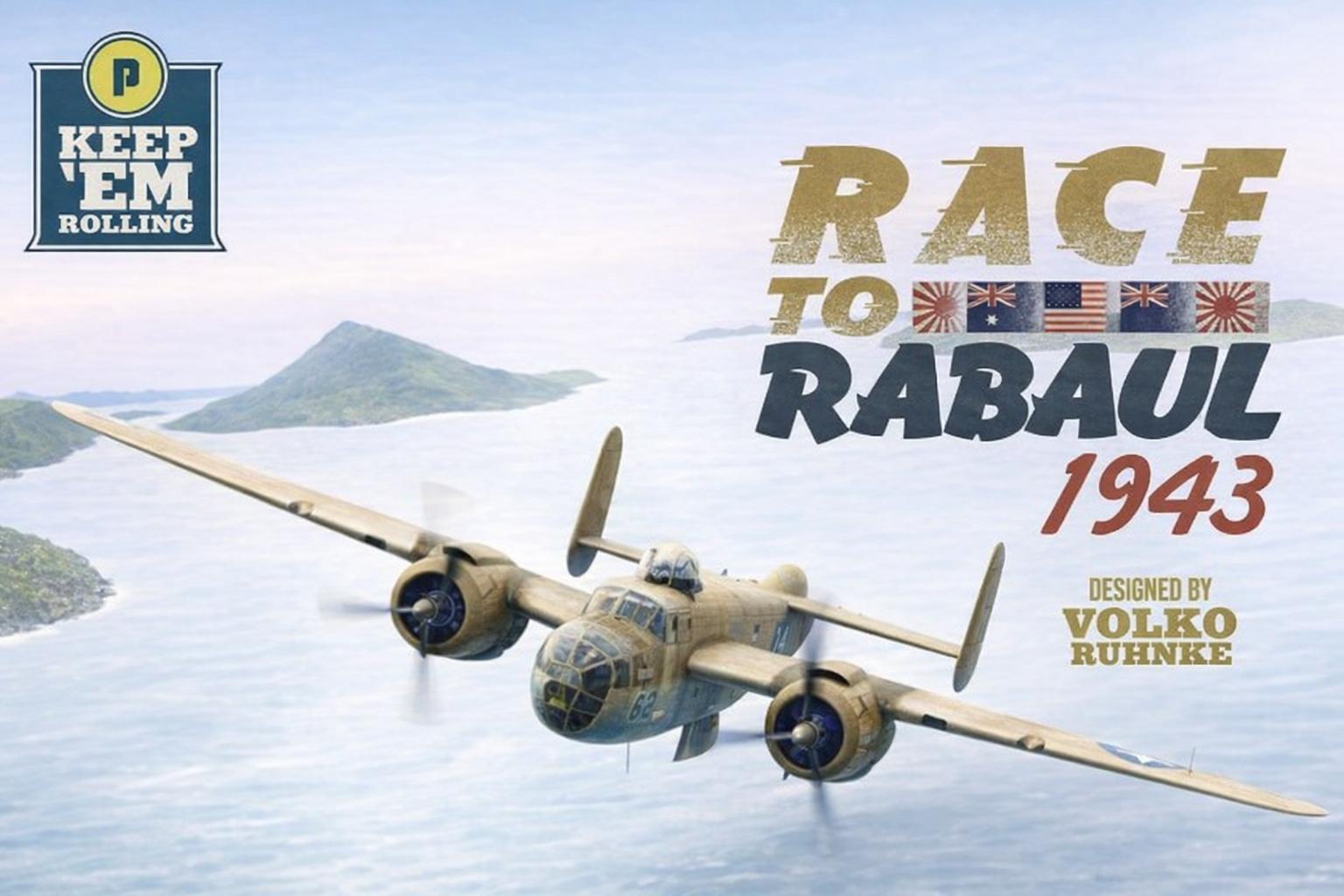
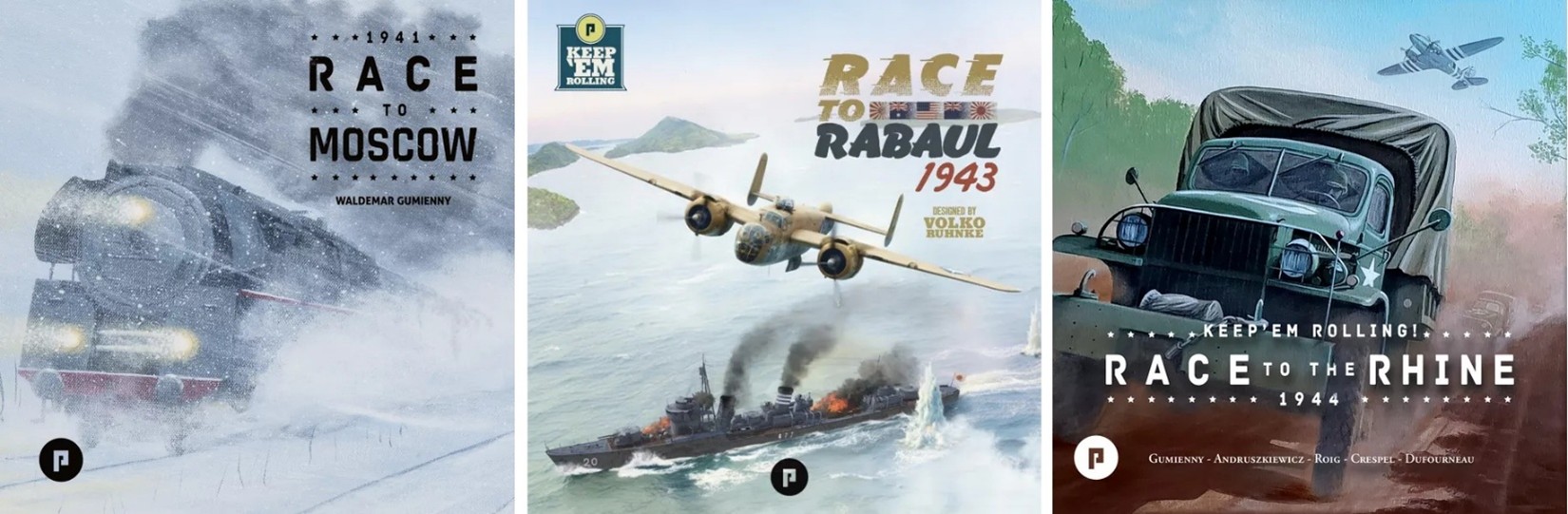
Oh yes! As the logo on the Race to Rabaul box shows, Phalanx is calling the series KEEP ‘EM ROLLING. The painting is by Rafał Zalewski and the titling is by Donal Hegarty.
In 1944: Race to the Rhine and 1941: Race to Moscow, players are Commanders racing to advance against an enemy that holds ground and inflicts losses. The speed of the advance brings logistical challenges – moving enough supplies fast enough. This becomes the main bottleneck for victory. The focus is on supply: providing, delivering, and consuming fuel, ammo, and food. Wooden game bits represent these supplies on the map.
I have played Phalanx’s Race games a lot. When Jaro Andruszkiewicz asked me to design a game with Phalanx, I knew quickly it had to be “1943: Race to Rabaul”. My starting point for the design would be the engine in Race to the Rhine and Race to Moscow.
So, at the heart of Race to Rabaul, fans will find mechanics that are comfortably familiar:
- Core and bonus actions, including Commander abilities and drawn cards.
- Ammo and Food bits.
- Unit display cards to hold them.
- Taking bits from a central stock to the players’ Supply Bases.
- Transport pieces, like Japanese Barge pieces that work like the trucks in Race to the Rhine.
- Air tokens.
- Combat determined by hidden cards and comparing bits.
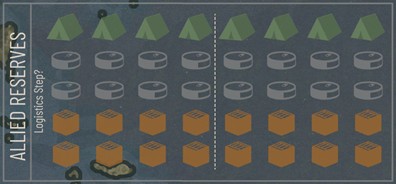
- Logistics steps to advance levels, consume Food, and reset reserves.
- Victory medals for taking enemy spaces and destroying enemy units.
– How did you feel about using an established system rather than starting a new series?
It certainly helped things go faster! There was a clear target for what the game should deliver from the start. Jumping in felt familiar to me. My first published designs many years ago – Wilderness War and Labyrinth: The War on Terror – each rested heavily on other designers’ popular games.
– Did your previous designs influence this game (like COIN, Levy & Campaign, or Coast Watchers)?
The COIN Series had me used to using wood bits to count assets, including troops. More interestingly, Levy & Campaign let me experiment with supply models showing amounts and locations of supplies across a map. It even included markers for transportation assets like carts, mules, and boats. So, when I discovered Phalanx’s Race games, I knew I could handle my own design within that series.
Designing Coast Watchers gave me the historical research to model logistics in the South Pacific of 1943. I needed a firm grasp of the offensive and counter-offensive campaigns. So I already knew the story of the Allied race to Rabaul in 1943 well.
– How is this theater different from other games in the “Race” series?
The specific campaign for Rabaul meant the design had to differ more from Rhine and Moscow than those two do from each other. There are three big differences in the South Pacific of 1943 compared to Russia 1941 or France 1944:
- We are racing not across farmland or steppes but along island chains and jungle coasts.
- The Japanese enemy impeding the Allied “race” is not on the run.
- Both sides – especially the Allies – must command not just logistics but counter-logistics.
– How did you adapt a system for land campaigns into an amphibious operation in the Pacific? What did you keep, drop, or add?
The maritime environment for the Allied push to seize or encircle Rabaul means combined arms are essential. Players will handle shipping lanes, attacks across straits, convoys, airbases, and air support alongside land advance across near-roadless interior.
To take us to the South Pacific, I had to adjust the earlier “Race” model. New features in Race to Rabaul include:
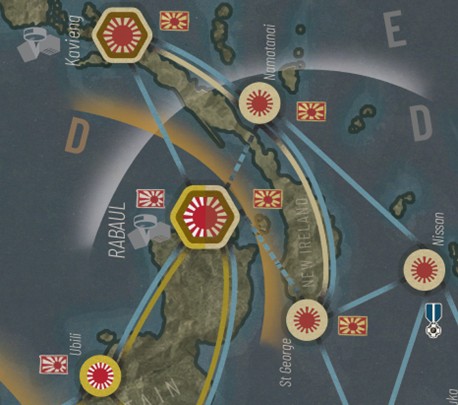
- Different kinds of connections between spaces: Land, Sea, Strait, and Coasts.
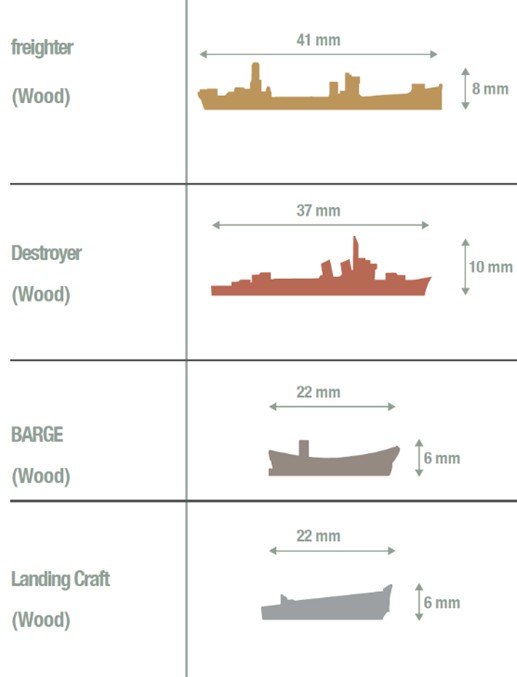
- Instead of trucks or trains, we use three types of Japanese Convoys plus Allied Landing Craft pieces.
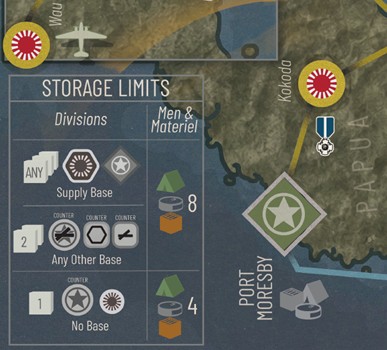
- With almost all land movement by foot, we don’t need Fuel bits. Instead, we show transport of fighting units over water. Troops take the place of Fuel. We have “Men and Materiel” instead of just “Supplies.” Ammo is useful in combat only if enough Troops are there to use it. Troops without Ammo or Food are highly vulnerable. Lack of Food removes individual Troop pieces. Allied Attack over Land costs Food – representing rations and protection against malaria.
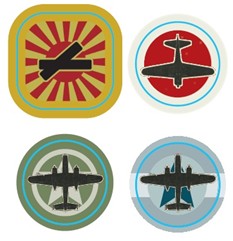
- We also get more Air support on both sides. The Allies must build new Airbases as they go forward so their Top Cover can protect Shipping Lanes and airstrikes can reach more Japanese Convoys.
- Finally, in the wide sea and impenetrable jungle, the Allies must first find the Japanese to strike them effectively. So Rabaul adds a new kind of Allied card: Intelligence.
– In the Pacific Theater, the Japanese are not on the run but execute an active defense. How is this reflected in the game?
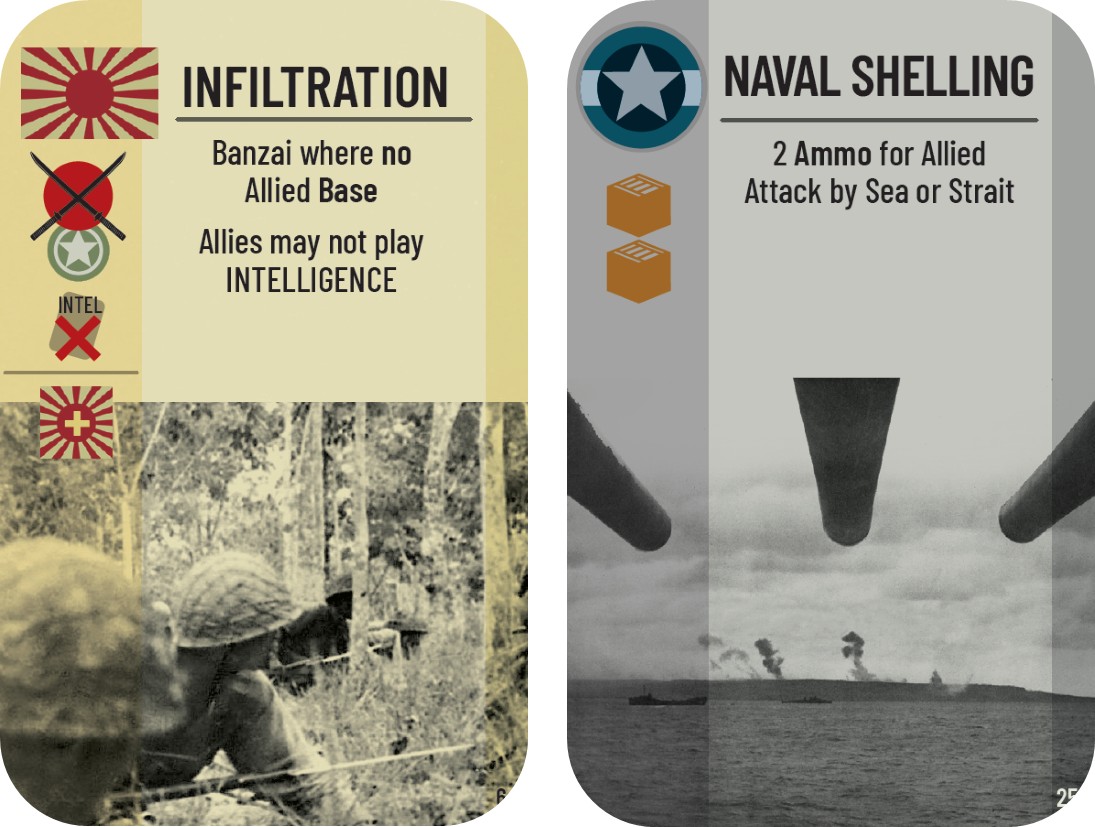
Imperial Japan’s troops are digging in to fight for every yard. Its naval forces organize to deliver reinforcements. Its air forces can still strike Allied positions. To show the tenaciousness and creativity of the Japanese defense, we put that active defense in the hands of players opposing the Allied Commanders.
This calls for more involved, asymmetrical, 2-sided combat. The Allies can attack over Land or across Straits, Invade by sea, Airdrop, and bypass Japanese positions. The Japanese need to time “Banzai” counterattacks to wrongfoot the Allies and inflict Troop casualties. Success can force the withdrawal of exhausted Allied Divisions.
As in Rhine and Moscow, combat in Rabaul compares numbers of bits on the map and on cards. But this time, the enemy is not just a random card flip but a human opponent. What cards will they play or hold back? Are they bluffing?
Player decisions also concern the locations and timing of Airbase building and Japanese fortification. Both are tied to Logistics Steps that reflect the pace of operations, largely in the hands of the Allied players.
The result is a true wargame rather than a “war euro.”
– One key to Allied success was their counter-logistic strategy. Can you elaborate on this and how it is presented in Race to Rabaul?
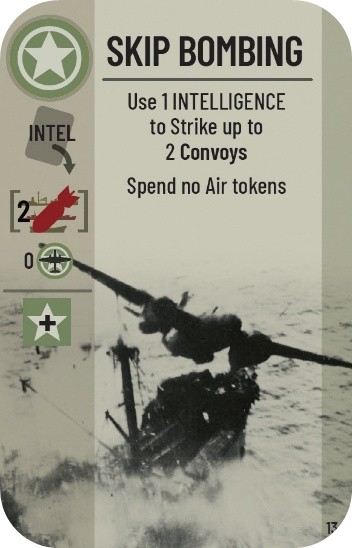
Instead of attacking fully ready Japanese strongpoints, the Allies from late 1942 onward used their growing air and naval advantage to cut off, bomb, and starve Japanese garrisons. Then they hit them once weakened – often from two directions.
In Race to Rabaul, Allied Commanders can strike and Sink or Abort Japanese Convoys to prevent delivery of Troops, Ammo, and Food. Allied Bombing and Land or Strait Attacks can reduce Japanese Men & Material before a full-scale Invasion.
Effective Japanese play will try to slip more Men & Materiel through the Allied blockade. Japanese Commanders can Bomb Allied Bases and Divisions. They will look to exploit any hitches in Allied resupply – striking enemy spearheads that might be inadequately resupplied after landing or assaulting a Fortified Base. Any Allied Troop losses in combat mean Medals for the Japanese.
– How many players will the game accommodate? How solitaire-friendly is it?
The rules in 1943:Race to Rabaul enable games with 2, 3, or 4 players. Each side – Japanese and Allied – has a pair of Commanders. So that’s 4 Commander roles total. One player can take each. But a single player can take the roles of both Commanders on a side, so 2 players could face off as Japanese versus Allies. Or 3 players can play 2 Allies versus a single player as both Japanese Commanders, or the reverse.
There is also an option for 2 players to play a smaller game on just half the map – New Guinea or the Solomons.
Folks online have suggested assigning each of 2 players the opposite side on each half of the map. I had not thought of that, but I think it would work!
For multi-handed play by a solo player, you would have to deal with hidden information. Each Commander gets a hand of cards not known to other players. Which Bonus actions a Commander may do next and the resolution of Attacks relies on play of these unrevealed cards. So a single player would have to do their best to get around that hidden knowledge.
I did not design a solitaire system to not slow down the project. My hope is that, if players like the game, someone will design solitaire play for it.
– What way will victory be determined in Race to Rabaul?
The first Commander to 12 medals wins. Like the other KEEP ‘EM ROLLING games, you earn medals mainly by capturing spaces and destroying enemy units. But, since only the Allies are taking enemy spaces, the Japanese have a different key way to earn medals: by holding certain spaces representing the “Bismarcks Barrier” for as many Logistics Steps as possible. The Allies set the campaign tempo and trigger Logistics Steps. But when they do so, the Japanese get a medal – until the Allies have broken the Bismarcks Barrier.
– As for the American players, leading MacArthur and Halsey, how do these two different theaters and commanders work together and how are they separate?
As in Rhine and Moscow, Commanders on the same side each race up their own track. MacArthur (green) is conquering New Guinea, while Halsey (blue) fights up the Solomon Islands chain. The two tracks meet at Rabaul. But long before the Allies reach it, they can choose to help each other or to compete.
Bombing actions can reach anywhere on the map, and Convoy Strikes within either Commander’s strike range. So you can help your partner by hitting the opposite track’s Japanese with your Air.
You can share Intelligence. You can help your Allied partner by playing your Intelligence cards to enable your partner to Strike Convoys, hold off Banzai Attacks, and succeed in Allied Invasions.
Allied actions typically determine when shared Logistics Steps occur. Allied players will do well to coordinate when to trigger the next Logistics Step.
– Now, looking at the Japanese side, how does this game present the famous interservice rivalry between Japanese Army and Navy?
Historically, Imperial Japanese Army and Navy forces fought together in New Guinea and the Solomons. But New Guinea – with larger land forces and fighting in the mainland interior – was more the Army’s purview. The Solomons fighting with major naval surface engagements was a region of greater Navy focus.
Rabaul portrays the Japanese side as two Commanders: one for the Army and one for the Navy. They must cooperate to win. The Army Commander controls land units and some air assets. The Navy Commander controls naval units, convoys, and the rest of the air assets. They share the same supply pool of Men & Materiel. They must coordinate to get supplies to the front and to launch attacks. If they do not work together, they will fail.
The game reflects the historical rivalry by giving each Commander their own strengths and limitations. The Army is strong in defense on land but needs the Navy to bring supplies. The Navy is strong at sea and in the air but needs the Army to hold ground. They must communicate and plan together to stop the Allied advance.
– What is the overall feel of playing the game?
The game feels tense. The Allies are pushing forward, but they are always worried about their supply lines. The Japanese are dug in, but they are slowly being squeezed. The map shows the vast distances and difficult terrain. The supply bits show the struggle to keep the armies fed and armed.
It is a game of decisions. When to push forward? When to build an airbase? When to save your cards for a big attack? The Japanese player must decide when to counterattack and when to hold back. The hidden cards add a layer of bluff and surprise.
It feels like a real command challenge. You are not just moving pieces; you are managing a whole campaign. You have to think about logistics, air power, and ground attacks all at once.
– Is the game difficult to learn?
If you have played the other Race games, you will pick this up quickly. The core system is the same. The new rules for the Pacific setting are explained clearly. If you are new to the series, there might be a learning curve. The rules are detailed to cover the historical situations. But the flow of the game is logical. You take actions, move units, handle supply, and fight battles. It follows a clear sequence.
– What was the biggest challenge in designing this game?
The biggest challenge was adapting the land-based logistics system to the sea-based reality of the Pacific. The other Race games focus on trucks and trains moving over land. Here, we have ships and landing craft moving over water. The Allies have to build airbases to support their advance. The Japanese have to defend islands and coastlines. Making all these elements work together smoothly was the main task.
Also, making the Japanese defense feel active and dangerous was important. In many war games, the defender is passive. Here, the Japanese can launch strong counterattacks. Balancing that so the Allies still have a chance to win was a key design goal.
– What are you most happy with in the design?
I am very happy with how the logistics system captures the historical struggle. The feeling of trying to move supplies across the ocean while the enemy tries to sink your ships is very strong. I also like the way the Allied players have to coordinate their two fronts. It feels true to the history of MacArthur and Halsey working together. And the Japanese side really feels like a team effort between Army and Navy.
– Any final thoughts for potential players?
If you enjoy the other Race games, you will find a lot to like here. It has the same tight logistics and tough decisions. If you are interested in the Pacific War, this game offers a deep look at the campaign to take Rabaul. It is a big game with a lot of history packed into it. I hope people enjoy playing it as much as I enjoyed designing it.