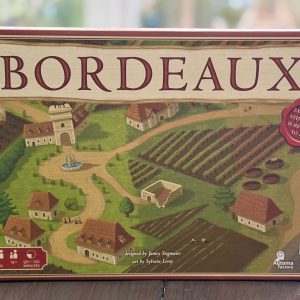
If the style and colors on the Ayar box look familiar, that is because they are. We are looking at the next game from Osprey Games featuring the team of Fabio Lopiano handling the game design and Ian O’Toole creating the art. Mandela F-G is also credited with the design. When you look at the box, you might think of games like Merv and Sankoré. Ayar does things differently from those earlier games, but it keeps the same feeling and atmosphere while offering something totally new. I think it might be the best of the group.
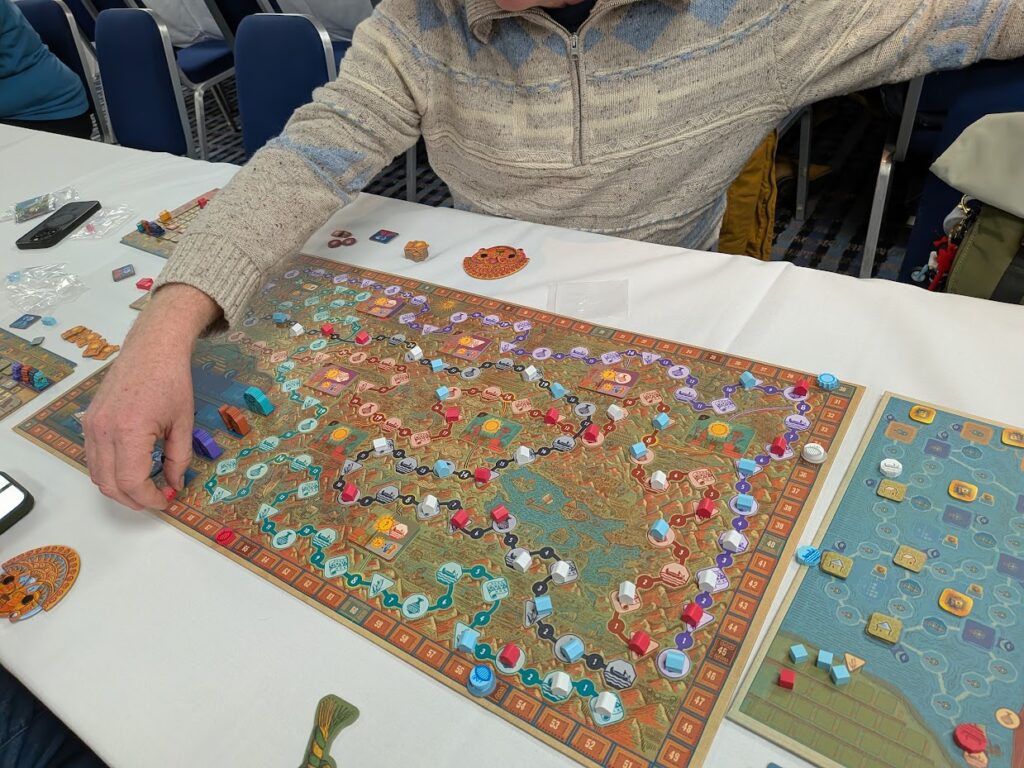
The story behind Ayar is, like many Euro games, something you will likely forget or ignore right away. The original Incan creator brought forth Sun and Moon gods, which then created four pairs of siblings. These siblings traveled the Earth until only two remained, who then founded the Incan empire. You will not remember or feel any of this while you play the game, but it does not matter. We are Eurogamers, right? The theme is nice to have, but not essential.
Trailblazers
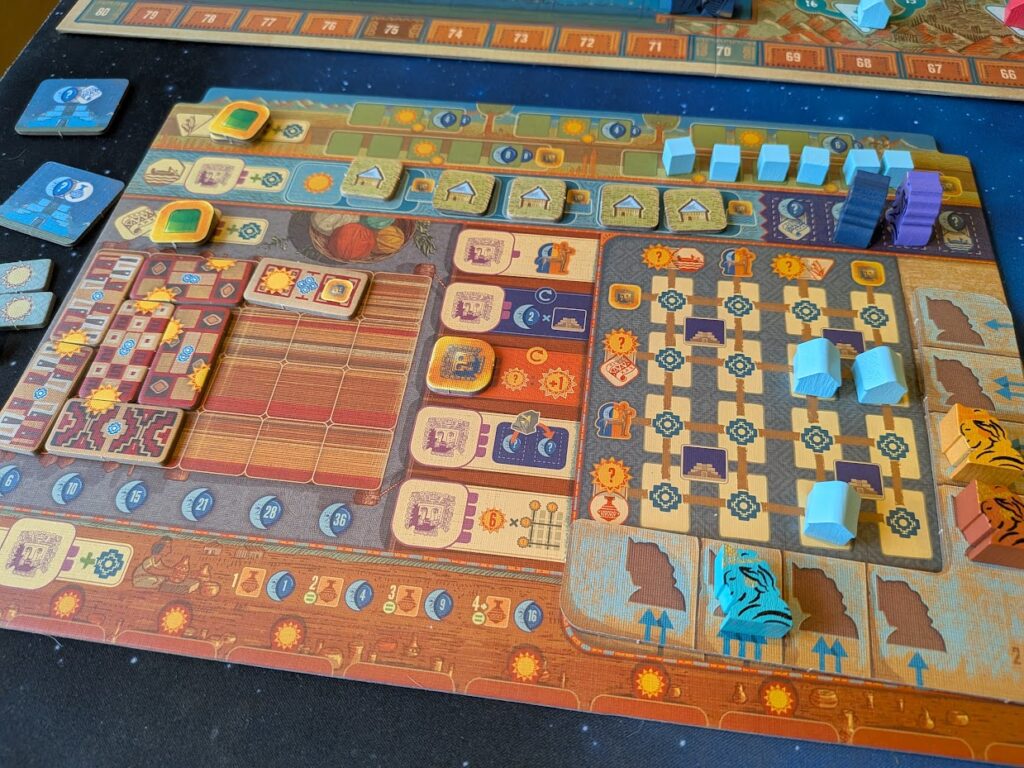
Ayar is, like those games mentioned before it, a collection of four mini-games combined into one larger game. If you use Sankoré as a comparison, Ayar is much simpler. The agricultural action, for example, is simply lifting cubes from your player board and putting them on the side board. Tapestry actions involve taking small 2×1 tapestry tiles and arranging them on your player board, trying to fill columns and get little half sun icons to match up. The pottery action lets you take tiles from the market to make matching colored sets. The most difficult action is the boat action which lets you spend action points to move across a map, dropping building tiles along the way.
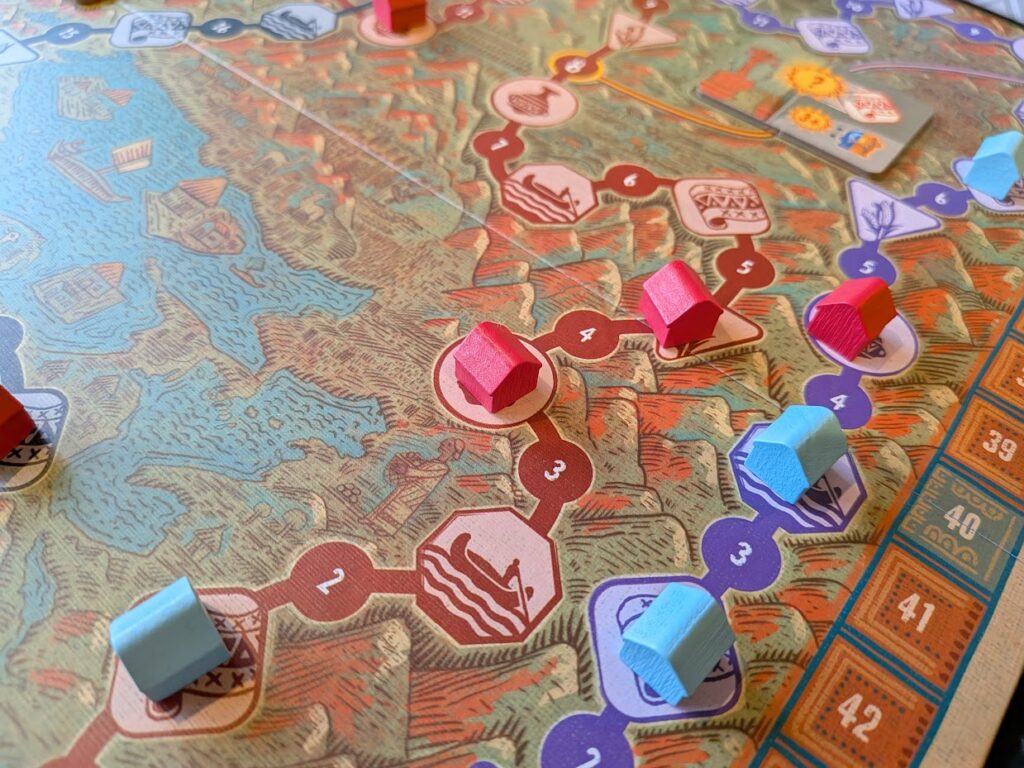
The number of action points you have for each of the game’s fifteen turns determines how strongly you can perform each action. This means buying better or more numerous tapestries or pots. It also means dropping more agriculture cubes from your board, or moving more spaces along the boat board. The game’s hook comes from how you earn these action points.
You choose one of the columns or rows on your board and place one of the colored step markers on it. You take a little house, called a Tambo in the game, from that row and place it on the action spot you want to take. The number of now-empty spaces on the row or column is the strength of your action. If you take the fourth building off, you get four points to spend. This is pretty easy to understand, right?
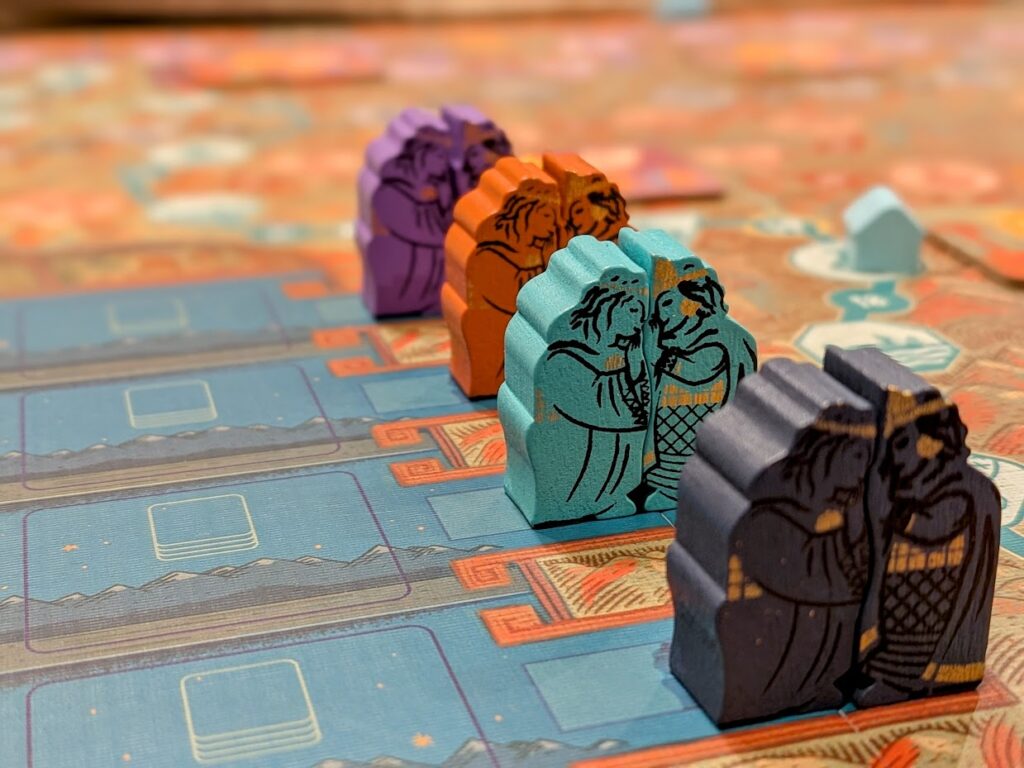
The difficulty, as it were, is in choosing which step marker to place. Each marker matches the color of one of the Ayar figures on the main board. These figures stand on a numbered spot on a winding path across the board. Between each numbered spot is an action space with an icon for one of the four game actions. You move the Ayar the number of spaces indicated on your board, then place your house on any of the spaces behind the Ayar. This is where things start to get complicated. If you are trying to do the same actions as the other players, your choices can get limited quite quickly.
You snooze, you lose
You might think that with four Ayar figures moving along four tracks, there is never going to be a fight for the type of action space you want. Ayar turns this on its head by retiring the furthest back figure at the end of each round. That last placed Ayar triggers some temple scoring, but from that point on there are only three tracks with action spots. You also lose the matching step marker at the same time. So while the first round of the game sees you taking five actions on the four different tracks, the subsequent rounds see you taking four actions, then three. In the final round, you only get two. Granted, these actions get stronger, but it is an interesting puzzle to wrap your head around.

Scoring is a strange beast in Ayar. It has the feel of a Reiner Knizia game because you constantly try to balance two scoring markers. At the end of the game, the smaller of the two, sun or moon points, is your final score. What makes it really interesting to me is the way these two scoring tracks differ.
Moon points trigger in batches throughout the game. Whenever you score them, either by temple tiles being triggered by retiring Ayars or retiring step markers on your board, you usually get a nice big dump of points at a time. Sun scoring is a different creature. You have a score dial which you add points to whenever sun scoring is triggered. This is not too often, but points never come off the dial. It is cumulative, so every time you trigger it you get more points than the last time.
It means that heading into the final round it can look like your sun points might only just break 20, while you have already crested 100 moon points. But those last few activations of the sun dial can do some real heavy lifting.
Eggs in baskets
As is true in many modern games, Ayar is pretty open-ended when it comes to choosing a strategy. You can go steaming in on one or two actions, going for a real min-max approach. Or, if you prefer not having all your eggs in one basket, you can slowly chip away at all four and make a more considered approach. The difficulty comes with future planning and predicting the way the game is going to go.
To be accurate, it is actually about predicting and influencing the future of the game. There are only a few opportunities to trigger sun scoring during the game. More than 50% of them can come from the main board. There are sun tiles randomly distributed along the paths the Ayars take. When they get as far as a tile, that particular sun scoring is triggered for everyone.
As I mentioned above, though, an Ayar leaves the board at the end of each round. You know what that means. No Ayar on a path, no sun score triggering. So much of playing the game, at least playing the game well, lives in this part of the design. You can see right from the start of the game which Ayars will trigger which sun tiles. You have a limited, shared ability to determine which Ayar will kick the bucket in each round. If you go headlong into one particular action right from turn one, it can reap some pretty hefty dividends later in the game. But this is only true if you can keep the Ayars you need on the board.
It is a wobbly walk along a very bouncy tightrope, and it is a puzzle I really enjoy trying to solve.
Final thoughts
I make no secret of the fact that I like Fabio Lopiano’s games. Even though I thought they used to end too soon, like Merv and Zapotec, and even though this series of games through Osprey all seem to be a collection of four minigames. Merv was great, but very tight. Sankoré was also really good, but heavy and difficult to understand the scoring mechanism. I found this left some new players confused and less-than-enthused to play again. Ayar, in contrast, seems to have found the sweet spot.
There is a lot to like here. First and foremost, it is quick. I have taught and played it with three and four players, and even then the teach and game last no more than two hours. It feels refreshing when most of the games I play these days tend to fill three hours. Despite its relative brevity, it still feels like a chunky game with a big, beige sandbox to play in. Every time I play it, I try something different. Granted, most times I usually lose, but I like the fact I can experiment while staying competitive. I also know that it will be days instead of months before I play it again.
I am not a fan of overproduction in games, but in Ayar’s case, I think it really could have done with double-layer player boards. All of the wooden pieces sit on a flat piece of card. Should you bump the table, if they end up in the wrong place, it can drastically affect the state of your game. The solo mode is a pleasure to play. It is quick and easy to run, and a great way to practise. But Ayar is really at its best with three or four players.
If you are looking for a middle-weight Euro with a lot of scope for experimenting, player-driven game states, and a really interesting set of diminishing actions, Ayar is worth a look. It is the best of the three in the series.
You can buy Ayar right now from my retail partner, Kienda. Head over to the page to get more details and even get a 5% discount on your first order.