There are certain games from childhood that stick with you forever. For me, that game was Crossbows & Catapults. I have vivid memories of the wars my brother and I waged on our kitchen floor. We would fling plastic caroms at his beige castle walls, screaming with excitement. It was pure, chaotic fun. Now, as a parent, I have the new version of that game, and playing against my kids with updated weapons is still a blast. When I picked up a review copy of Little Soldiers at SPIEL Essen last year, it immediately gave me those same nostalgic vibes.
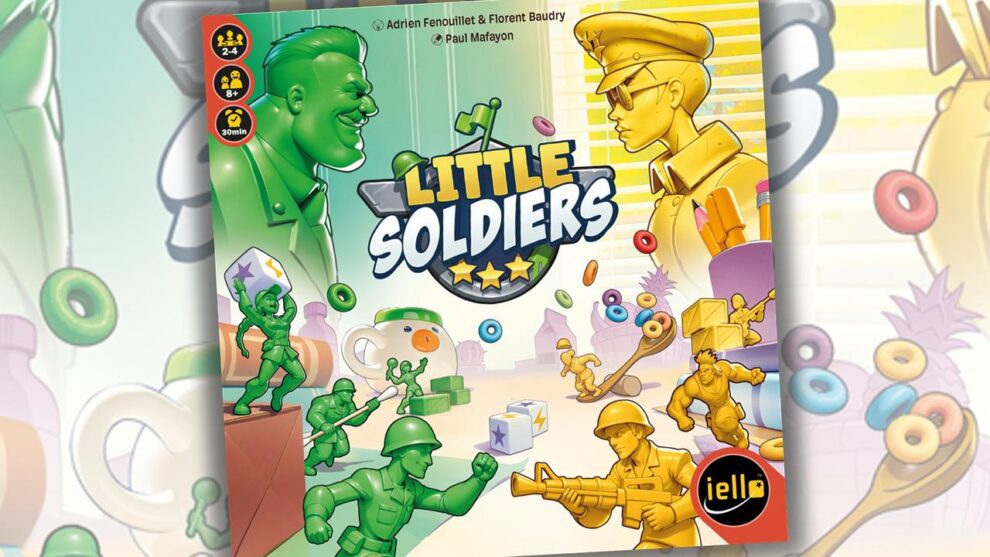
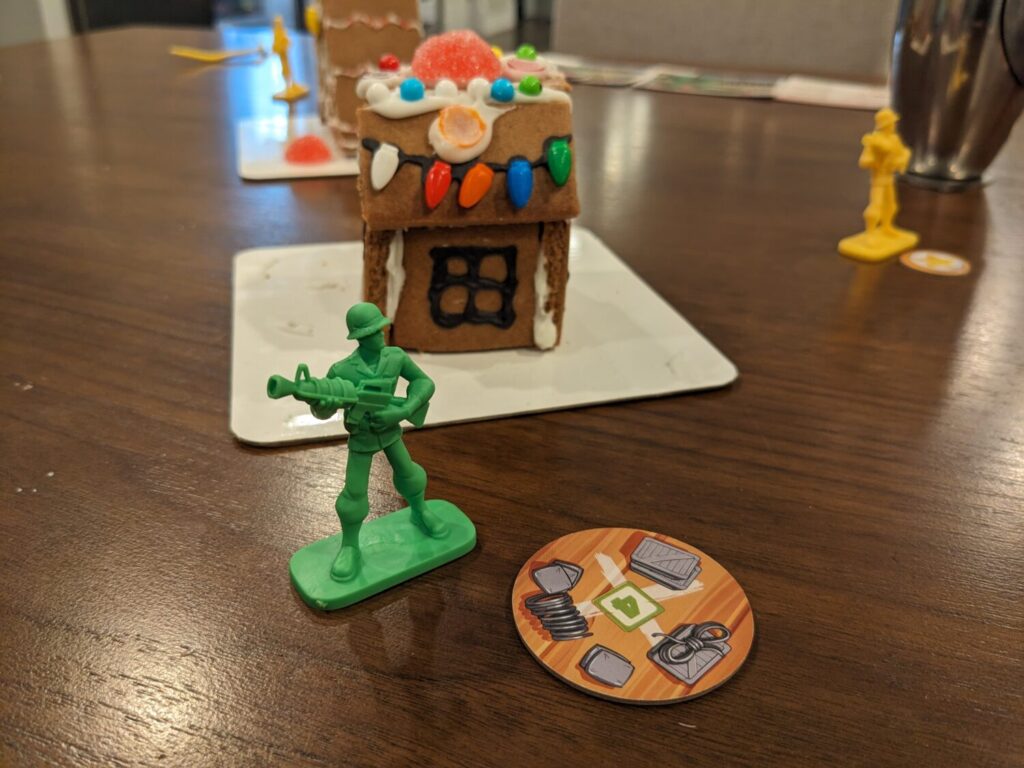
Published by IELLO, Little Soldiers (2025) swaps out the human and goblin warriors for simple green and yellow plastic soldiers. However, the biggest change is how you build the battlefield. Instead of a massive box of plastic parts to construct castle walls, Little Soldiers makes setup incredibly easy. You simply need common household items that are taller than the soldiers. In our recent plays, we used metal canteens, other board games, gingerbread houses, and plastic cups. This flexibility means Little Soldiers is harder to classify as a traditional board game. After all, there is no actual board. That part is fine, though. As one user online commented, it feels less like a strict board game and more like a box of toys with scenario rules that can turn whatever you have into the game.
Setting Up the Battle
With that frame of mind, results may vary depending on your creativity. Little Soldiers is a very light wargame experience designed for two or four players. While there may be options for three players, I mostly stuck to two-player games since there are two simple armies to control. The game includes respawn points, 2-5 soldiers per side, and dice used for simple line-of-sight combat. The combat resolution is straightforward: roll more hits than a soldier has armor to create damage. Enough damage kills a soldier, but they can respawn in a later round.
The game comes with many different rule sets, so I won’t cover them all here. The core objective is almost always the same: take out more enemy soldiers than your opponent does. Turns are easy to understand. You move a soldier, use action tokens to activate your chosen soldiers, and then take a single action with them. This action could be another move, a shoot action, or a special ability that varies by the soldier type.
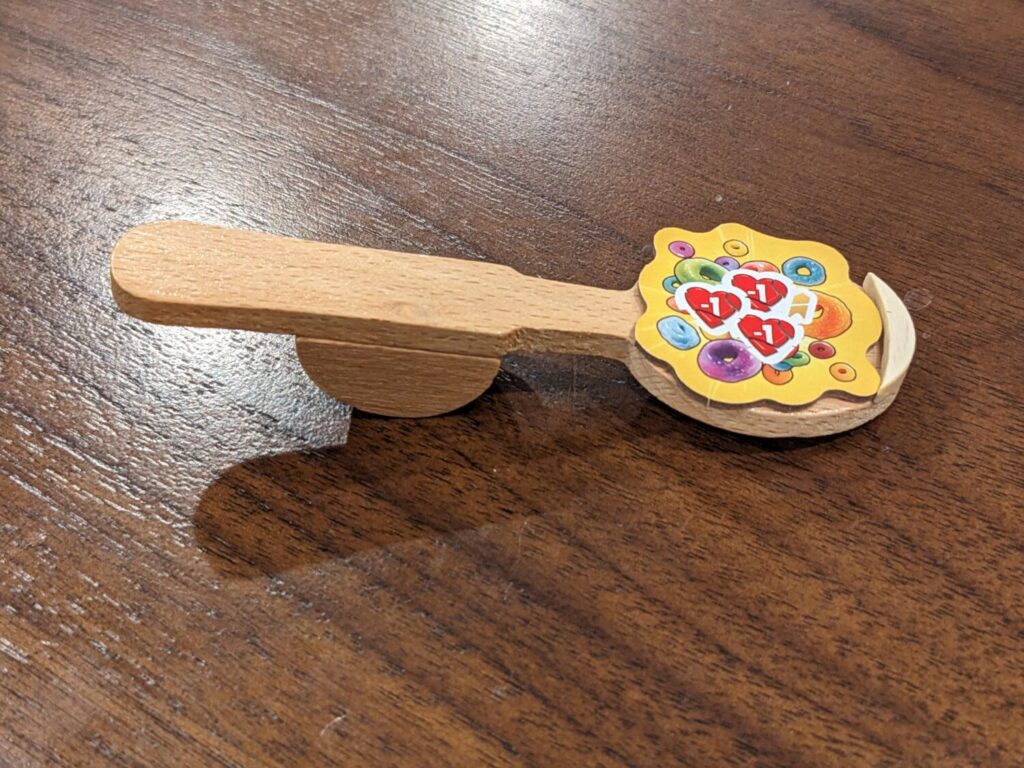
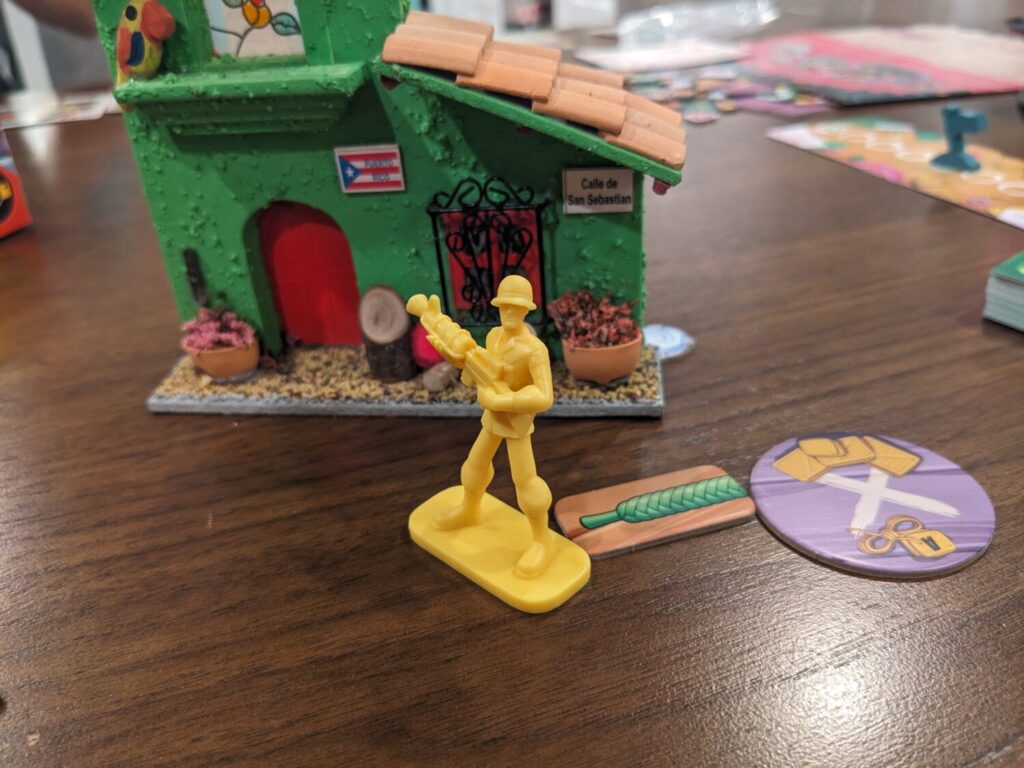
Some abilities are basic, like trying to lower a target’s defense value. Others are more complex, such as lobbing grenades or mortar shells at a targeted area. This uses a special token and a component my family now calls the “grenade spoon.” It is essentially a spoon on a fulcrum that does a pretty terrible job of flinging a cardboard token, which adds a layer of humorous frustration to the game.
Gameplay Mechanics and Depth
The basic game format, called “Boot Camp,” is so shallow that I would advise skipping it even if you are playing with children. My nine-year-old son found Boot Camp so boring that he offered to stop our already short three-round game in round two. Moving into module and/or campaign modes adds more variety to the experience. However, I was surprised to report that Little Soldiers never quite became interesting enough to recommend highly in any format.
The best attribute of Little Soldiers is its simplicity. I believe it will land best for games strictly between children. My nine-year-old might have more fun with this if he played it only with other kids his age. As an adult, I was bored with the combat structure almost immediately. Moving into a target’s line-of-sight using the short movement strings makes setting up an attack pretty easy. Getting closer to a target only gives a player a chance at an additional re-roll, on top of the single re-roll granted in most combat situations. It doesn’t offer enough tactical depth to keep an adult engaged.
I do love that some characters have special abilities that may cause themselves harm. For example, the sniper’s extra die can be helpful, but one of the die faces actually hurts the sniper, introducing a small element of risk. Using items from my kitchen for the board offered nice flexibility, but the reality was that we constantly used things that were easy to grab and plop on the table. However, the soldiers still need to move across flat surfaces because of the movement rules. This means you aren’t getting deep, height-based combat modifiers for such a simple game.
Who Is This Game For?
As an activity for parents looking for ways to entertain younger kids (let’s say ages 4-6), Little Soldiers might be worth a look. It is particularly suitable if you are seeking a dice-based challenge rather than a dexterity challenge. If your kids are older and dice games are your thing, Halo: Flashpoint was a much bigger success in my household. Halo: Flashpoint had a lot more going on, with a ruleset that was very simple to administer and better-looking terrain.
Despite the fact that Little Soldiers sat on my kitchen table for about a week after our first play, my nine-year-old didn’t want to revisit the game. That’s about where I landed, too. It is a fine activity for a rainy afternoon, but it is not a formative gaming experience that we will remember years from now.